
A U.S. guide to the October 7, 2026 Shapiro Google-review ruling, New York anti-SLAPP procedure, fee risk, evidence, and removal strategy. This United States guide addresses what the October 7, 2026 New York appellate decision in Shapiro v. Kushnick-Carr changes for businesses considering defamation litigation over a Google review, especially the threshold distinction between actionable fact and protected opinion, New York anti-SLAPP procedure, and potential attorney-fee exposure from a lawyer-grade evidence and platform perspective. The goal is not to promise deletion. The goal is to help a business preserve a useful file, avoid avoidable public-response mistakes, and decide whether Google reporting, a legal notice, subpoena-readiness review, or local counsel escalation is proportionate.
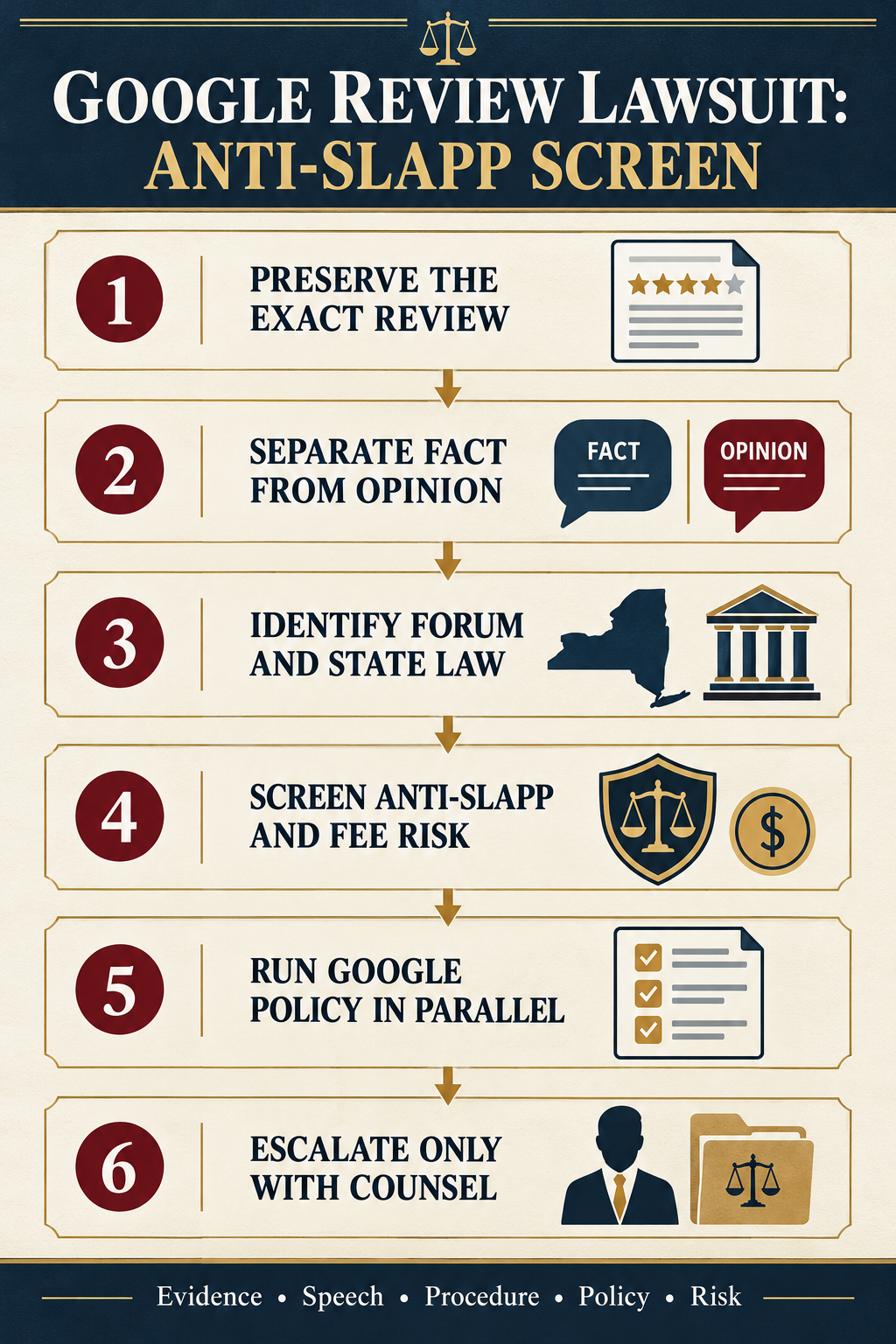
The working scenario is this: a licensed professional receives a harsh one-star Google review written in capital letters and rhetorical language. Management sees reputational harm, wants immediate removal, and proposes a six-figure defamation demand. The review contains no specific accusation of crime, fraud, professional discipline, or undisclosed misconduct, but the business assumes that hostile tone and commercial impact are enough to sue. Before any notice is sent, the team must decide whether the words are verifiable facts, opinion, hyperbole, or mixed opinion; whether New York's anti-SLAPP statute may apply; and whether Google policy provides a narrower route. A rushed reaction usually weakens the case. A business may reply publicly before it has searched records, accuse the wrong person, submit private documents to Google, or threaten litigation over language that is closer to opinion than fact. A stronger approach slows the dispute down just enough to classify the words, preserve the proof, and select the narrowest route that fits the evidence.

Legal Issue Framing
In U.S. review disputes, Shapiro is a New York intermediate appellate decision applying New York law, not a nationwide rule for every Google review. The Appellate Division, Second Department treated the public Google Business Profile as a public forum, treated professional competence as an issue of public interest in that case, held the challenged rhetoric to be nonactionable pure opinion, dismissed the complaint, granted attorney fees and costs, and remitted only the amount of the award. The decision does not make every review protected, every business a public figure, or every Google-review lawsuit a fee case. Defamation law is mainly state law, so exact elements, privileges, damages rules, limitation periods, and anti-SLAPP exposure can vary. Still, a practical national screen is useful. Ask whether the review was published to third parties, whether it identifies the business or a person connected to it, whether the challenged words imply a fact capable of being proved true or false, whether that fact is false or materially misleading, and whether the publication caused reputational harm.
The Supreme Court references are important but should be used carefully. Milkovich is useful because a statement labeled as opinion can still imply an assertion of objective fact. New York Times v. Sullivan matters where public-official or public-figure standards are implicated, but many ordinary business review disputes involve private figures under state-law rules. The business should not overstate the constitutional point in a Google report. Google is not deciding a trial; it is deciding whether content violates platform policy.
Use the case study with the USA guide to anti-SLAPP risk in Google review lawsuits, while the United States Google review removal page explains the broader country-specific platform and service strategy.
Evidence Checklist
The evidence file should begin before anyone contacts the reviewer. Preserve the review URL, profile URL, display name, star rating, full text, photos, visible edit history, publication date, Google Business Profile context, local-search position if relevant, and screenshots from desktop and mobile where possible. Then compare the allegations with the exact review and all versions; the Business Profile, category, location, direct review and reviewer-profile URLs; rating, punctuation, capitalization, images, owner replies, and surrounding context; every concrete proposition the business says is false; records proving or contradicting each proposition; whether the post implies undisclosed detrimental facts; the identity of every proposed plaintiff; the governing forum and state law; limitation, notice, anti-SLAPP, fee, and damages issues; Google report and appeal history; harm evidence; proposed demand language; and a proportionality memo comparing platform, correction, response, and litigation routes. A no-match conclusion should identify which systems were searched, who searched them, when, and what limitations remain.
The strongest file is a sentence-by-sentence table. One column quotes the exact words. One column states what an ordinary reader may understand. One column classifies the phrase as opinion, hyperbole, insult, factual accusation, private information, threat, fake-engagement signal, or off-topic content. Other columns identify proof for and against, non-confidential evidence that can be shown to Google, private evidence reserved for counsel, response risk, and potential harm.
- Save the review, profile, URL, screenshots, star rating, images, publication date, edit evidence, and Business Profile context.
- Compare the challenged statements with the exact review and all versions; the Business Profile, category, location, direct review and reviewer-profile URLs; rating, punctuation, capitalization, images, owner replies, and surrounding context; every concrete proposition the business says is false; records proving or contradicting each proposition; whether the post implies undisclosed detrimental facts; the identity of every proposed plaintiff; the governing forum and state law; limitation, notice, anti-SLAPP, fee, and damages issues; Google report and appeal history; harm evidence; proposed demand language; and a proportionality memo comparing platform, correction, response, and litigation routes.
- Preserve negative checks: no booking found, no invoice found, no matching visit, no branch record, or a partial match with inaccurate allegations.
- Keep confidential records separate from the Google submission; summarize sensitive facts instead of uploading private customer, staff, payment, health, student, legal, or HR data.
- Document harm with contemporaneous proof such as prospect questions, canceled bookings, rating movement, sales impact, staff concern, partner concern, and report or appeal outcomes.
- Create one chronology that tracks first discovery, preservation, internal review, Google reports, appeals, notices, public responses, and any off-platform messages.

Platform-Policy Angle
Google's own review-reporting workflow should be used with a moderator-readable file. The submission should identify the exact review, the policy category, the non-confidential facts that support the category, and the requested action. For this topic, the likely policy angle may involve a concrete Google category such as fake engagement, a non-genuine experience, rating manipulation, conflict of interest, impersonation, harassment, personal information, off-topic content, or another policy violation supported by non-confidential facts. Harsh opinion, rhetorical insult, poor grammar, or commercial harm alone does not establish a Google policy violation, just as a rejected Google report does not decide the merits of a defamation claim. The important point is precision: a review may be legally troubling but still require a policy explanation before Google can act.
Google's prohibited and restricted content policy is the operational map. It covers categories such as fake engagement, misrepresentation, harassment, personal information, off-topic content, and conflicts of interest. A business should not ask Google to decide every state-law issue. It should explain why the review fails Google's own rules and support that explanation with a concise chronology. If the problem includes review extortion, use Google's dedicated extortion route as well as the ordinary review-reporting route where the facts fit.
The business must also avoid becoming the policy problem. The FTC Consumer Reviews and Testimonials Rule materials documents the federal rule approved in August 2024; the final rule became effective October 21, 2024 and addresses deceptive or unfair conduct involving consumer reviews and testimonials. A harmed business should not buy counter-reviews, pressure customers to edit truthful criticism, create insider reviews without proper controls, review-gate only happy customers, or make groundless public accusations to suppress a lawful review.
Recent Development: New York Appellate Court Dismisses A Google Review Case And Awards Fees
On October 7, 2026, the New York Supreme Court, Appellate Division, Second Department issued Shapiro v. Kushnick-Carr, 2026 NY Slip Op 05822. The court reversed the Nassau County trial court, dismissed an attorney's defamation complaint arising from a review on the public Google profile for his law firm, granted the reviewer costs and attorney fees under New York Civil Rights Law Section 70-a, and sent the case back only to determine the amount. The decision is a genuine current development for Google-review disputes because it analyzes the review forum, the professional subject matter, the words and style of the post, the fact-opinion boundary, the anti-SLAPP dismissal standard, and fee consequences in one compact ruling.
The official decision and order is dated October 7, 2026 and was published by the New York State Law Reporting Bureau. It is an intermediate appellate ruling applying New York law. The online opinion is marked uncorrected and subject to revision before publication in the Official Reports. The public decision does not establish that further review has been sought or granted, and the amount of fees had not been fixed because the matter was remitted for that calculation. Those limits matter: the decision should be described as a significant, current New York authority, not as a final nationwide rule or a guarantee that every critical Google review is protected.
What The Court Actually Decided
The first holding was procedural. Under Civil Rights Law Section 76-a, the court treated the claim as an action involving public petition and participation. The Google review appeared on a publicly accessible business profile and concerned the professional competence of a licensed attorney serving the public. In that setting, Google was a public forum and the subject was not purely private. Once the reviewer made that showing, CPLR 3211(g) required the plaintiff to demonstrate that the claims had a substantial basis in law or were supported by a substantial argument to change existing law.
The second holding concerned meaning. The court examined the specific language and context rather than treating hostility as falsity. It found the criticism subjective and imprecise, closer to a familiar idiom and a vague expression of disapproval than to an accusation capable of proof. It also relied on the consumer-review setting and the post's hyperbolic presentation. Because the review did not accuse the attorney of a specific crime, wrongful act, professional misconduct, or undisclosed detrimental fact, the court treated it as nonactionable pure opinion. With no substantial basis for the defamation claim, the court also granted fees and costs under Civil Rights Law Section 70-a.
The decision did not hold that capitalization, punctuation, a one-star rating, or placement on Google automatically converts language into opinion. Nor did it decide a case involving a concrete assertion such as a fabricated invoice, a false claim of theft, a provably nonexistent transaction, a forged license allegation, or a specific accusation of professional discipline. The analysis remained tied to the exact words, their precision, whether they were verifiable, what context signaled to a reasonable reader, and whether the post implied undisclosed facts.
Run The Fact-Opinion Screen Before Sending A Demand
A pre-suit team should test every challenged sentence using three questions reflected in Shapiro: does the language have a precise meaning, can it be proved true or false, and does the context signal fact or opinion? The broader constitutional reference remains Milkovich v. Lorain Journal Co., which warns that simply adding an opinion label does not immunize a statement that reasonably implies an objective factual assertion. The work is therefore not to count insults. It is to identify the proposition a reasonable reader would understand and the evidence that could prove or disprove it.
- Quote each challenged statement exactly and preserve its punctuation, capitalization, emojis, images, star rating, surrounding sentences, Business Profile context, and visible edits.
- Write the most reasonable factual meaning management says the statement conveys; reject meanings that require confidential facts or lawyer-created context ordinary readers did not have.
- Mark disclosed opinion, vague evaluation, rhetorical hyperbole, precise factual assertion, and mixed opinion that may imply undisclosed facts as separate categories.
- For each proposed factual meaning, identify affirmative proof, contrary proof, missing records, potential truth or substantial-truth issues, privileges, and the correct plaintiff.
- Have counsel test the actual forum's law rather than assuming the New York analysis governs a review, speaker, business, or lawsuit located elsewhere.
The screen should be skeptical in both directions. A business should not call a review factual merely because it is harmful, emphatic, or commercially damaging. It also should not abandon a serious file merely because the reviewer uses phrases such as 'I think' or 'in my opinion.' A statement may still imply verifiable facts about fraud, safety, licensing, billing, discrimination, theft, data misuse, or professional conduct. The legal question is contextual meaning, not the presence of a verbal disclaimer.
Anti-SLAPP Screening Is A Cost And Procedure Decision
The Shapiro lesson is not limited to who ultimately wins. CPLR 3211(g) provides a special dismissal standard and stays discovery when the relevant motion is filed, subject to limited court-authorized discovery on specified essential facts. Civil Rights Law Section 70-a provides for recovery of costs and attorney fees when the statutory conditions are met. A business that sends a lawsuit threat without modeling dismissal timing, proof available before discovery, defense costs, fee shifting, appeal expense, publicity, and management time may be making a larger commercial decision than the initial review suggests.
Anti-SLAPP rules differ materially across the United States. Some are broad and procedural; some are narrow; some include fee shifting, special motions, discovery stays, interlocutory appeals, or claim-specific exclusions; and federal-court treatment can require separate research. The proposed plaintiff, forum, causes of action, review subject, timing, and relief requested all matter. A national business should never paste a California or New York anti-SLAPP paragraph into a demand letter without checking the jurisdiction that can actually hear the dispute.
Create a written go/no-go memorandum before escalation. It should state the exact false fact, evidence available now, expected defenses, public-interest analysis, governing forum, anti-SLAPP mechanism, discovery constraints, realistic harm proof, proposed remedy, budget, fee downside, insurance notice issues, and non-litigation alternatives. If the team cannot express the case in that form, a six-figure threat is premature even when the review is upsetting.
The Evidence File Must Preserve Context, Not Just A Screenshot
Preserve a full-page capture with the direct URL, Business Profile name and location, reviewer identity as displayed, review date, edit label, star rating, text, images, owner reply, and nearby context. Capture desktop and mobile if the presentation changes. Save the original files, note the date, time, time zone, browser and collector, and calculate a hash where proportionate. A cropped image that removes the review setting can destroy the very context a court may use to distinguish factual accusation from online hyperbole.
Then create a version ledger. Review text, images, reviewer profile, and owner response can change. Record each known version, how it was discovered, and what changed. Preserve Google notifications, report confirmations, appeal IDs, customer messages referring to the review, search results showing the profile, and transaction records. Keep originals untouched; use working copies for highlights. If the reviewer later adds a specific factual accusation, do not overwrite the earlier opinion-heavy version with the new capture.
Separate evidence by audience. The privileged counsel file can contain sensitive records and legal analysis. The Google package should contain the minimum non-confidential material needed to prove a policy category. The public response should reveal less. A law firm, clinic, school, employer, financial service, or other confidentiality-sensitive business should not disclose client status, treatment, student information, personnel facts, payment data, or privileged communications merely to rebut a one-star post.
Google Policy Is A Parallel Track, Not An Anti-SLAPP Appeal
Google's review-reporting guidance says only reviews that violate policy are eligible for removal and tells businesses not to report a review merely because they dislike or disagree with it. A one-time appeal may be available after a no-violation decision. For a Shapiro-type criticism, harsh opinion may remain online if it reflects a genuine experience and violates no product rule. A stronger platform file identifies a supported category in the prohibited and restricted content policy: for example, no genuine experience, wrong location, paid or coordinated engagement, conflict of interest, impersonation, harassment, personal information, or off-topic content.
Product-policy reporting and legal reporting should remain distinct. Google's legal-reporting guidance provides a separate route for content claimed to violate applicable law. That route still requires exact URLs, exact challenged material, an accurate legal basis, and appropriate authority. A business should not submit Shapiro as though New York law automatically governs another state, and it should not tell Google that an anti-SLAPP dismissal rule itself proves a review violates platform policy. Conversely, a rejected platform report does not prove that a specific false factual allegation is lawful.
Public Response And Notice Strategy After Shapiro
The safest public response is usually short and audience-focused. It may state that the business takes the concern seriously, is checking records, and invites the reviewer to use an official private channel. If the business cannot identify the transaction, it can say that available records do not presently allow the matter to be verified, provided that statement is accurate. Do not use the reply to announce a lawsuit, quote the review again, reveal confidential proof, diagnose the reviewer, or accuse the person of criminality, extortion, competitor activity, or fabrication without a reviewed evidence basis.
A private notice can be firmer, but it should still separate opinion from demonstrably false fact, identify the evidence, request a proportionate correction or preservation step, and acknowledge material uncertainty. The FTC's Consumer Reviews and Testimonials Rule materials and 16 C.F.R. Section 465.7 are important guardrails because federal review-suppression rules address certain unfounded or groundless legal threats, intimidation, and false public accusations used to prevent or remove negative reviews. Legitimate legal action remains possible; unsupported pressure is the risk.
Escalation Criteria And Material Uncertainty
- Escalate when the review contains a precise, serious factual accusation contradicted by objective records, especially allegations of crime, fraud, unsafe conduct, licensing failure, discrimination, falsified records, or professional misconduct.
- Escalate when the reviewer appears to be a competitor, non-customer, former employee, coordinated participant, impersonator, or extortion actor and the relationship can be documented lawfully.
- Escalate before a deadline, retraction notice, anti-SLAPP response, subpoena, emergency-relief request, insurance notice, or evidence-retention period may expire.
- Pause when the challenged words are vague criticism, disclosed personal evaluation, rhetorical flourish, or substantially true description of a real dispute, or when the business lacks evidence available before discovery.
- Obtain local counsel when New York law may apply, when another state's anti-SLAPP regime may control, or when management wants a demand or filing that could expose the company to fees.
The uncertainty is substantive and procedural. Shapiro is current New York appellate authority, but its opinion classification depended on the exact wording and context before the court. Other reviews may contain specific, provably false assertions or implied undisclosed facts. Other states define public interest, anti-SLAPP coverage, burdens, fees, and appeals differently. The opinion was marked uncorrected, the fee amount was left for the trial court, and public sources reviewed for this article do not establish a completed further appeal. The practical response is careful screening, not a categorical claim that businesses cannot sue or that reviewers always win.
Public Response Strategy
The public response should be written for future readers, Google, and a later evidence file. It should usually be short, factual, and privacy-safe. The business can state that it takes the matter seriously, that available records are being reviewed, and that the reviewer can contact an official private channel. The response should not disclose the evidence package. The main risk here is turning criticism into a larger public dispute, repeating the review's allegations, accusing the reviewer of lying or criminal conduct without proof, using an unsupported lawsuit threat to seek deletion, ignoring anti-SLAPP fee exposure, disclosing professional-client or customer information, or treating a platform appeal as evidence that state-law litigation will succeed.
A public reply can become a screenshot in a later platform appeal, regulator complaint, media post, or lawsuit. Avoid calling the reviewer a criminal, extortionist, competitor, ex-employee, fake customer, or liar unless counsel has reviewed the evidence and the business accepts the risk. If the review contains private data, staff names, customer identifiers, health information, payment details, student information, legal-client facts, or HR allegations, the public response should be screened before publication.
Escalation Criteria
Escalation is not a single move. It may mean a stronger Google appeal, a legal-preservation letter, a narrow demand letter, private outreach, subpoena-readiness review, local counsel referral, law-enforcement consultation for true extortion facts, or a state-law defamation assessment. Escalation is most defensible when the accusation is specific, factual, serious, contradicted by objective records, causing measurable harm, and not adequately addressed by ordinary platform reporting.
Expectations about the platform should remain realistic. 47 U.S.C. Section 230 generally limits attempts to treat an interactive computer service as the publisher or speaker of third-party content. That does not protect the person who wrote a false review, and it does not stop the business from using Google's policy channels. It does mean that a legal strategy aimed directly at the platform needs careful analysis and usually should not be the first assumption.
- Escalate when the review makes a serious factual accusation such as fraud, theft, unsafe conduct, falsified records, discrimination, or professional misconduct.
- Escalate when the reviewer appears to be a non-customer, competitor, former staff member, supplier, transaction opponent, or part of a coordinated pattern.
- Escalate when there are threats, demands for value, personal information, images, harassment, or repeated publication across platforms.
- Escalate when Google rejects a first report because the submission lacked policy framing, chronology, or non-confidential evidence.
- Escalate when a public response would create privacy, employment, consumer-protection, confidentiality, or retaliation risk.
Risk Cautions
The Consumer Review Fairness Act, codified at 15 U.S.C. Section 45b, restricts certain form-contract provisions that prohibit, penalize, or transfer rights in honest consumer reviews. It does not protect fake, defamatory, harassing, confidential, or unlawful content, but it does warn businesses against overbroad anti-review tactics. A removal strategy should target false or policy-violating statements, not silence ordinary criticism.
The second caution is evidentiary discipline. Do not delete internal notes, alter customer records, post confidential documents, offer payment for deletion, send a template threat without reviewing state law, or submit a long emotional narrative to Google. A business should keep one clean file and separate what can be shown publicly, what can be summarized to Google, and what should remain with counsel.
Sources Consulted
- Google Business Profile Help: report inappropriate reviews.
- Google prohibited and restricted content policy.
- Milkovich v. Lorain Journal Co., 497 U.S. 1 (1990).
- New York Times v. Sullivan, actual-malice framework.
- 47 U.S.C. Section 230.
- FTC Consumer Reviews and Testimonials Rule materials.
- 15 U.S.C. Section 45b, Consumer Review Fairness Act.
- Shapiro v. Kushnick-Carr, 2026 NY Slip Op 05822 (App. Div. 2d Dept. Oct. 7, 2026).
- Official four-page Shapiro decision and order.
- New York Civil Rights Law Section 70-a, costs and attorney fees.
- New York Civil Rights Law Section 76-a, public petition and participation.
- New York CPLR 3211(g), anti-SLAPP dismissal standard and discovery stay.
- Google Maps user-generated content policy.
- Google Legal Help: Defamation Overview.
- Google Legal Help: report content for legal reasons.
- 16 C.F.R. Section 465.7, review suppression.
Practical Conclusion
Shapiro is a sharp screening lesson, not a universal immunity rule. Before threatening suit over a U.S. Google review, preserve the full publication, separate precise factual assertions from disclosed opinion and hyperbole, identify the governing state and anti-SLAPP regime, model fee exposure, and run any supported Google policy route in parallel. A serious, demonstrably false factual accusation may justify escalation; vague criticism may not. State-specific counsel should review the words, context, procedure, and evidence before a demand or filing, and no case citation or platform report guarantees removal or recovery.
Pimlegal's preliminary role is to organize the review evidence, frame the platform policy route, keep the public response proportionate, and identify when the matter should move to U.S. counsel for jurisdiction-specific legal advice. This article is general information only. It does not guarantee review removal, identify a final legal remedy, or replace state-specific counsel review.