
A U.S. guide to choice of law in multistate Google review defamation, covering forum, state contacts, evidence, policy, and escalation. This United States guide addresses which state's substantive and procedural rules may govern a multistate Google review defamation dispute, and why jurisdiction, venue, governing law, Google policy, and the location of reputational harm must be analyzed as separate questions from a lawyer-grade evidence and platform perspective. The goal is not to promise deletion. The goal is to help a business preserve a useful file, avoid avoidable public-response mistakes, and decide whether Google reporting, a legal notice, subpoena-readiness review, or local counsel escalation is proportionate.
The working scenario is this: a reviewer living in Texas posts a one-star review about a Florida location of a Delaware company headquartered in New York. The review accuses a named California executive of fraud, is read by customers in several states, and is edited after the company replies. Management assumes New York law controls because headquarters approved the response, while outside counsel is considering suit in federal court in Florida and the reviewer argues that Texas law and its speech-protection rules apply. A rushed reaction usually weakens the case. A business may reply publicly before it has searched records, accuse the wrong person, submit private documents to Google, or threaten litigation over language that is closer to opinion than fact. A stronger approach slows the dispute down just enough to classify the words, preserve the proof, and select the narrowest route that fits the evidence.

Legal Issue Framing
In U.S. review disputes, there is no single federal choice-of-law rule for state defamation claims. A court first applies the forum's conflict-of-laws method, subject to constitutional limits, and may analyze different issues under different states' rules. Personal jurisdiction answers whether a court may bind a defendant; venue addresses where the case may proceed; choice of law determines which jurisdiction's rules decide particular merits or procedural questions. Those inquiries can point in different directions. Defamation law is mainly state law, so exact elements, privileges, damages rules, limitation periods, and anti-SLAPP exposure can vary. Still, a practical national screen is useful. Ask whether the review was published to third parties, whether it identifies the business or a person connected to it, whether the challenged words imply a fact capable of being proved true or false, whether that fact is false or materially misleading, and whether the publication caused reputational harm.
The Supreme Court references are important but should be used carefully. Milkovich is useful because a statement labeled as opinion can still imply an assertion of objective fact. New York Times v. Sullivan matters where public-official or public-figure standards are implicated, but many ordinary business review disputes involve private figures under state-law rules. The business should not overstate the constitutional point in a Google report. Google is not deciding a trial; it is deciding whether content violates platform policy.
Pair the governing-law analysis with the USA guide to personal jurisdiction in Google review defamation, while the United States Google review removal page explains the broader country-specific platform and service strategy.
Evidence Checklist
The evidence file should begin before anyone contacts the reviewer. Preserve the review URL, profile URL, display name, star rating, full text, photos, visible edit history, publication date, Google Business Profile context, local-search position if relevant, and screenshots from desktop and mobile where possible. Then compare the allegations with the review and every version; direct review and profile URLs; publication, edit, response, and discovery timestamps; the Business Profile location and service area; reviewer residence and relevant conduct if lawfully known; plaintiff incorporation, headquarters, branches, employee locations, and principal reputation markets; transaction and communication locations; audience and harm evidence by state; demand, response, and report history; candidate limitation periods, retraction rules, privileges, anti-SLAPP statutes, damages rules, and conflict methods; and facts supporting or opposing each proposed forum. A no-match conclusion should identify which systems were searched, who searched them, when, and what limitations remain.
The strongest file is a sentence-by-sentence table. One column quotes the exact words. One column states what an ordinary reader may understand. One column classifies the phrase as opinion, hyperbole, insult, factual accusation, private information, threat, fake-engagement signal, or off-topic content. Other columns identify proof for and against, non-confidential evidence that can be shown to Google, private evidence reserved for counsel, response risk, and potential harm.
- Save the review, profile, URL, screenshots, star rating, images, publication date, edit evidence, and Business Profile context.
- Compare the challenged statements with the review and every version; direct review and profile URLs; publication, edit, response, and discovery timestamps; the Business Profile location and service area; reviewer residence and relevant conduct if lawfully known; plaintiff incorporation, headquarters, branches, employee locations, and principal reputation markets; transaction and communication locations; audience and harm evidence by state; demand, response, and report history; candidate limitation periods, retraction rules, privileges, anti-SLAPP statutes, damages rules, and conflict methods; and facts supporting or opposing each proposed forum.
- Preserve negative checks: no booking found, no invoice found, no matching visit, no branch record, or a partial match with inaccurate allegations.
- Keep confidential records separate from the Google submission; summarize sensitive facts instead of uploading private customer, staff, payment, health, student, legal, or HR data.
- Document harm with contemporaneous proof such as prospect questions, canceled bookings, rating movement, sales impact, staff concern, partner concern, and report or appeal outcomes.
- Create one chronology that tracks first discovery, preservation, internal review, Google reports, appeals, notices, public responses, and any off-platform messages.

Platform-Policy Angle
Google's own review-reporting workflow should be used with a moderator-readable file. The submission should identify the exact review, the policy category, the non-confidential facts that support the category, and the requested action. For this topic, the likely policy angle may involve fake engagement, misrepresentation, conflicts of interest, harassment, personal information, off-topic content, or another concrete Google category supported by non-confidential evidence. Google's moderators do not need to resolve a fifty-state conflict-of-laws dispute, and a policy report should not present one state's defamation label as a universal removal rule. The important point is precision: a review may be legally troubling but still require a policy explanation before Google can act.
Google's prohibited and restricted content policy is the operational map. It covers categories such as fake engagement, misrepresentation, harassment, personal information, off-topic content, and conflicts of interest. A business should not ask Google to decide every state-law issue. It should explain why the review fails Google's own rules and support that explanation with a concise chronology. If the problem includes review extortion, use Google's dedicated extortion route as well as the ordinary review-reporting route where the facts fit.
The business must also avoid becoming the policy problem. The FTC Consumer Reviews and Testimonials Rule Q&A states that the federal rule went into effect on October 21, 2024 and addresses deceptive or unfair conduct involving consumer reviews and testimonials. A harmed business should not buy counter-reviews, pressure customers to edit truthful criticism, create insider reviews without proper controls, review-gate only happy customers, or make groundless public accusations to suppress a lawful review.
Forum, Jurisdiction, Venue, And Governing Law Are Different Questions
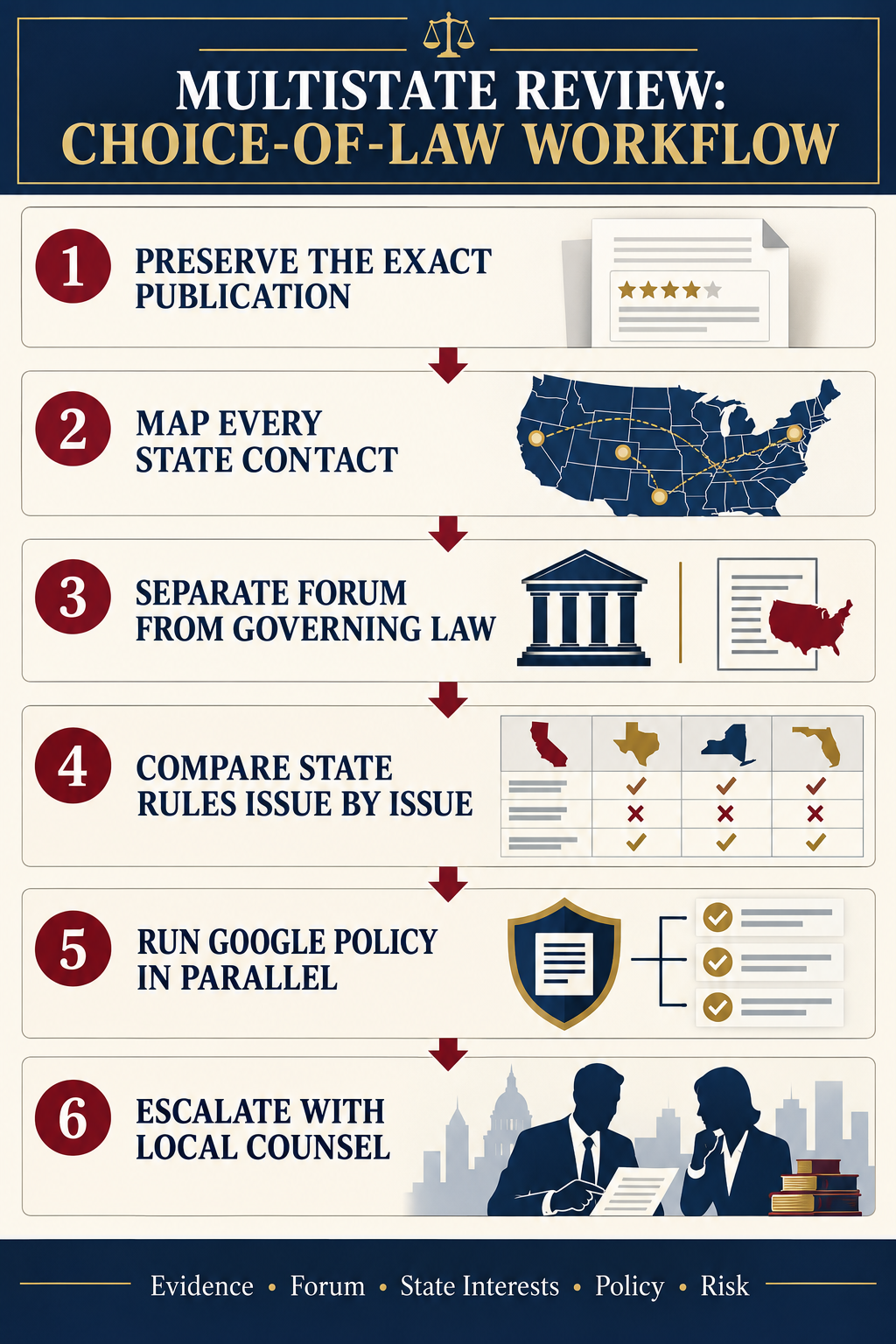
A multistate review creates several legal maps at once. Personal jurisdiction asks whether a particular court has authority over a defendant. Subject-matter jurisdiction asks whether the dispute belongs in that court system. Venue concerns the proper geographic court within that system. Choice of law asks which jurisdiction's rules govern a particular issue. A court may have jurisdiction in State A, sit in a proper venue there, and still apply some or all of State B's law. A Google report is a fifth track governed by platform policy rather than by the court's conflict analysis.
That separation matters before a business sends a demand. The state named in the letter affects limitation periods, retraction requirements, fault standards, privileges, presumed or special damages, anti-SLAPP exposure, fee shifting, and available relief. Selecting law because the company is headquartered there, because counsel is admitted there, or because a review can be opened there is not a substitute for applying the forum's conflict method to a documented set of contacts.
The distinction also prevents misuse of jurisdiction cases. Keeton v. Hustler Magazine allowed New Hampshire jurisdiction based on regular circulation there in a libel dispute, and Calder v. Jones sustained California jurisdiction over defendants whose intentional conduct was expressly aimed at California and caused injury there. Those decisions are important forum authorities. They do not create a rule that the same state's substantive defamation law automatically controls every claim or issue.
The Forum Supplies The Conflict Method
For a state-law claim in federal diversity jurisdiction, Klaxon Co. v. Stentor Electric Manufacturing Co. requires the federal court to apply the conflict-of-laws rules of the state in which it sits. That rule blocks a national federal choice-of-law method from displacing the forum state's approach. A business considering a federal filing under 28 U.S.C. Section 1332 therefore still needs to know the forum state's conflicts rules, not merely the federal pleading standard.
State approaches are not uniform. Depending on the forum and issue, courts may emphasize the place of injury, the place of publication or conduct, the parties' domiciles, a most-significant-relationship analysis, governmental interests, or another state-specific method. Some courts treat particular questions separately. That issue-by-issue practice is sometimes called depecage: one state's law may govern liability while another rule is considered for limitations, privilege, damages, or procedure. The label is less important than documenting which issue is being analyzed and why the selected state has a legitimate connection to it.
The first counsel memo should therefore identify the proposed forum, quote its actual conflict rule, list each candidate state, and compare the result for each disputed issue. It should not begin with a conclusory sentence that the law of headquarters, incorporation, or the reviewer's residence governs the whole case. If transfer, dismissal, removal, or refiling could change the forum, the team should model how that change may affect the conflicts analysis before committing to a threat or deadline position.
Constitutional Limits Are A Floor, Not A Complete Answer
Allstate Insurance Co. v. Hague explains the constitutional boundary: the state whose law is selected must have a significant contact or significant aggregation of contacts creating state interests, so the choice is not arbitrary or fundamentally unfair. The decision does not prescribe one nationwide conflicts test. It recognizes that more than one jurisdiction may constitutionally supply law to the same set of facts, leaving the forum's own conflict rules to make the selection within those limits.
For an online review, the constitutional contact file should be concrete. Record where the reviewed location operated, where the transaction occurred, where the reviewer acted, where the plaintiff and named individuals were based, where the publication was directed, where an audience actually encountered it, and where identifiable reputational or economic injury appeared. Mere global availability is not the same as proof of meaningful publication, targeting, or harm in every state.
Sun Oil Co. v. Wortman is also a warning against simplistic labels. The Supreme Court upheld the forum's treatment of statutes of limitations as procedural for the constitutional question before it and addressed the limits on a state court's interpretation of another state's law. A Google review team should not turn that holding into a claim that limitations periods are always procedural. Forum rules, borrowing statutes, claim characterization, accrual, single-publication doctrine, and state precedent still require specific research.
Build A State-Contact Ledger Before Choosing A Rule
Use one row per legally relevant event rather than one row per state mentioned by management. For every event, record the date, actor, location, source, confidence level, and the issue it may affect. Separate verified contacts from assumptions and preserve the evidence that supports each entry. A reviewer display name, IP inference, customer address, branch record, corporate filing, ad campaign, or sales report may prove different things and may carry different privacy restrictions.
- Publication contacts: the Business Profile location, direct review URL, original posting and edit dates, reviewer-facing location signals, languages, and evidence of actual audience access by state.
- Party contacts: incorporation, principal place of business, branch locations, reviewer residence if lawfully established, named employee locations, and the identity of each proposed plaintiff.
- Transaction contacts: where services were requested, performed, paid for, refunded, delivered, or disputed; where relevant calls, emails, contracts, and records originated.
- Conduct contacts: where the challenged words, photographs, owner response, demand, or republication were created or approved, without assuming a remote approval location controls the tort.
- Injury contacts: customer inquiries, cancellations, lost opportunities, employee impact, partner concern, press pickup, rating movement, and revenue effects tied to identifiable markets rather than a national estimate.
- Procedure contacts: proposed court, removal or transfer possibilities, service location, existing related proceedings, retraction notices, anti-SLAPP deadlines, and limitation-period triggers.
The ledger should also show missing evidence. If the team does not know where the reviewer lived, whether readers in a state saw the post, or which entity suffered the loss, say so. Unknown facts can shape discovery and subpoena strategy, but they should not be converted into affirmative statements in a demand letter or Google legal request.
Compare State Rules Issue By Issue
A useful comparison matrix begins with outcome-sensitive differences, not every possible legal rule. For each candidate state, record the elements of defamation and business-disparagement claims; fact-versus-opinion doctrine; truth or substantial-truth rules; public-figure, public-concern, and fault standards; corporate and individual claimant requirements; privileges; retraction or pre-suit notice provisions; limitations and accrual rules; single-publication and republication treatment; anti-SLAPP procedure; available damages; fee shifting; and the form of injunctive relief a court may entertain.
The matrix should flag characterization disputes. A rule one state treats as substantive may be treated as procedural elsewhere. A defamation count, trade-libel theory, false-light claim, interference claim, or statutory consumer-protection claim may follow different analyses. A court may reject a claim label designed mainly to evade a speech-protective rule. The business should identify the real injury and publication rather than assuming a different cause-of-action title will select more favorable law.
Federal constitutional defamation principles remain relevant regardless of state selection. The U.S. Constitution Annotated overview of defamation and false statements summarizes the First Amendment framework developed through Supreme Court decisions. But that constitutional floor does not erase state variation above it. State-specific research is still required for the precise plaintiff, words, subject matter, fault, privilege, injury, and remedy.
Publication, Editing, And Republication Need Separate Dates
Preserve the first visible review, each material edit, attached image, owner response, reviewer follow-up, and cross-platform repost as a separate event. Record when the business first discovered each version and who captured it. A later edit may change the allegedly false proposition, the ordinary-reader meaning, the policy category, the limitations analysis, or the evidence needed to authenticate the record. It may or may not constitute a new publication under the governing state's law.
Do not assume that Google's current display date proves the first publication date or every intervening change. Preserve notification emails, browser captures, exports, metadata, contemporaneous messages, report IDs, and cryptographic hashes where appropriate. If the owner response triggered a new review version, preserve both sides of the thread and the sequence. The team may need one chronology for platform moderation and a more complete chronology for counsel.
Google Policy Runs In Parallel To The State-Law Analysis
Google's prohibited and restricted content policy currently focuses on product categories such as fake engagement, misrepresentation, conflicts of interest, harassment, personal information, and off-topic content. A moderator does not need a fifty-state choice-of-law memo. The platform file should identify the exact content, the best-fitting policy provision, a concise non-confidential chronology, and the requested moderation action.
Google's Defamation Overview and legal-reporting guidance provide a separate legal route where appropriate. The legal submission should identify the exact URL and challenged words and explain the claimed legal basis accurately. It should not say that a particular state's law definitely applies unless counsel has a supportable conflicts analysis. A rejected product-policy report does not itself decide the merits of a defamation claim, and a choice-of-law disagreement does not prevent the business from making a precise policy report.
Keep disclosure levels separate. The Google policy package should use the minimum non-confidential evidence needed to support the category. The counsel file may contain customer records, corporate documents, audience evidence, and state-by-state legal research. The public response should contain less still. Choice-of-law proof is not permission to publish addresses, identity documents, personnel records, medical information, payment data, or confidential communications.
Demand Letters Must Not Overstate The Governing Law
A measured notice can preserve evidence, identify exact false factual statements, request correction, and invite a response without pretending every conflict issue is settled. State the factual and legal basis conditionally where research is incomplete. Avoid a nationwide damages claim built only from online accessibility, a forum threat chosen for expense rather than connection, or a deadline statement that ignores other candidate states. A notice should also preserve, rather than destroy, the distinction between the reviewer, Google, and any unrelated third party who repeated the allegation.
The FTC's Consumer Reviews and Testimonials Rule Q&A confirms that a business may threaten legitimate legal action but may not use an unfounded or groundless legal threat to prevent or remove a review. 16 C.F.R. Section 465.7 also addresses review suppression through threats, intimidation, and certain false public accusations. A weak conflicts analysis can therefore become more than a litigation problem if it is used as unsupported pressure against honest consumer speech.
A genuine false-review dispute can still justify action. The point is to match the notice to verified facts and a defensible legal path. If time is short, preserve all candidate deadlines and obtain advice in the states most plausibly connected to the claim rather than waiting for a perfect national memo or asserting the most favorable rule as settled.
Counsel Escalation Packet For A Multistate Review
- One clean capture set showing the review, profile, location, rating, images, owner response, edit markers, direct URLs, timestamps, and preserved versions.
- A claimant map separating the company, branch, owner, executive, professional, and employee allegedly identified by each challenged statement.
- A state-contact ledger with evidence citations, confidence levels, missing facts, and separate columns for publication, parties, transaction, conduct, audience, and harm.
- An issue matrix comparing candidate law for elements, fault, privileges, limitations, notice, anti-SLAPP, damages, fee exposure, and remedies.
- A forum memo separating personal jurisdiction, subject-matter jurisdiction, venue, transfer risk, forum conflict rules, and constitutional contacts.
- Three disclosure sets: public-response material, non-confidential Google policy evidence, and the complete privileged counsel file.
- A deadline sheet showing the earliest plausible limitation or notice date, report and appeal dates, preservation triggers, and responsible owner.
- A proportionality note stating the desired result, likely costs, business impact, weaknesses, alternatives, and why escalation is or is not justified.
Escalate promptly when candidate states materially differ on a deadline, retraction prerequisite, anti-SLAPP motion, privilege, fault standard, or damages rule; when several plaintiffs or Business Profiles are involved; when the reviewer or evidence location is uncertain; when a filing, subpoena, or injunction is being considered; or when management wants to make a categorical public accusation. The objective is not to maximize the number of states in the dispute. It is to identify the narrowest defensible route before an avoidable forum or choice-of-law mistake consumes the merits.
Public Response Strategy
The public response should be written for future readers, Google, and a later evidence file. It should usually be short, factual, and privacy-safe. The business can state that it takes the matter seriously, that available records are being reviewed, and that the reviewer can contact an official private channel. The response should not disclose the evidence package. The main risk here is announcing that a preferred state's law conclusively applies before forum analysis, confusing online accessibility with legally relevant publication or injury, threatening suit in a remote state without a defensible connection, missing a shorter deadline or pre-suit requirement, disclosing customer or employee records to prove state contacts, or using an uncertain legal theory as pressure to suppress an honest review.
A public reply can become a screenshot in a later platform appeal, regulator complaint, media post, or lawsuit. Avoid calling the reviewer a criminal, extortionist, competitor, ex-employee, fake customer, or liar unless counsel has reviewed the evidence and the business accepts the risk. If the review contains private data, staff names, customer identifiers, health information, payment details, student information, legal-client facts, or HR allegations, the public response should be screened before publication.
Escalation Criteria
Escalation is not a single move. It may mean a stronger Google appeal, a legal-preservation letter, a narrow demand letter, private outreach, subpoena-readiness review, local counsel referral, law-enforcement consultation for true extortion facts, or a state-law defamation assessment. Escalation is most defensible when the accusation is specific, factual, serious, contradicted by objective records, causing measurable harm, and not adequately addressed by ordinary platform reporting.
Expectations about the platform should remain realistic. 47 U.S.C. Section 230 generally limits attempts to treat an interactive computer service as the publisher or speaker of third-party content. That does not protect the person who wrote a false review, and it does not stop the business from using Google's policy channels. It does mean that a legal strategy aimed directly at the platform needs careful analysis and usually should not be the first assumption.
- Escalate when the review makes a serious factual accusation such as fraud, theft, unsafe conduct, falsified records, discrimination, or professional misconduct.
- Escalate when the reviewer appears to be a non-customer, competitor, former staff member, supplier, transaction opponent, or part of a coordinated pattern.
- Escalate when there are threats, demands for value, personal information, images, harassment, or repeated publication across platforms.
- Escalate when Google rejects a first report because the submission lacked policy framing, chronology, or non-confidential evidence.
- Escalate when a public response would create privacy, employment, consumer-protection, confidentiality, or retaliation risk.
Risk Cautions
The Consumer Review Fairness Act, codified at 15 U.S.C. Section 45b, restricts certain form-contract provisions that prohibit, penalize, or transfer rights in honest consumer reviews. It does not protect fake, defamatory, harassing, confidential, or unlawful content, but it does warn businesses against overbroad anti-review tactics. A removal strategy should target false or policy-violating statements, not silence ordinary criticism.
The second caution is evidentiary discipline. Do not delete internal notes, alter customer records, post confidential documents, offer payment for deletion, send a template threat without reviewing state law, or submit a long emotional narrative to Google. A business should keep one clean file and separate what can be shown publicly, what can be summarized to Google, and what should remain with counsel.
Sources Consulted
- Google Business Profile Help: report inappropriate reviews.
- Google prohibited and restricted content policy.
- Milkovich v. Lorain Journal Co., 497 U.S. 1 (1990).
- New York Times v. Sullivan, actual-malice framework.
- 47 U.S.C. Section 230.
- FTC Consumer Reviews and Testimonials Rule Q&A.
- 15 U.S.C. Section 45b, Consumer Review Fairness Act.
- Klaxon Co. v. Stentor Electric Manufacturing Co., 313 U.S. 487 (1941).
- Allstate Insurance Co. v. Hague, 449 U.S. 302 (1981).
- Sun Oil Co. v. Wortman, 486 U.S. 717 (1988).
- Keeton v. Hustler Magazine, Inc., 465 U.S. 770 (1984).
- Calder v. Jones, 465 U.S. 783 (1984).
- 28 U.S.C. Section 1332, diversity jurisdiction.
- U.S. Constitution Annotated: defamation and false statements overview.
- Google Maps user-generated content policy.
- Google Legal Help: Defamation Overview.
- Google Legal Help: report content for legal reasons.
- 16 C.F.R. Section 465.7, review suppression.
Practical Conclusion
A multistate Google review dispute should begin with a contact map, not a favored-state conclusion. Preserve every publication and edit, separate personal jurisdiction from governing law, compare candidate rules issue by issue, document where the parties, transaction, audience, and reputational injury are genuinely connected, and run Google's policy process in parallel. State conflict methods and constitutional limits can change the answer, so local counsel should confirm the governing law before a formal threat, filing, or deadline decision. No forum or choice-of-law theory guarantees removal, damages, or another legal outcome.
Pimlegal's preliminary role is to organize the review evidence, frame the platform policy route, keep the public response proportionate, and identify when the matter should move to U.S. counsel for jurisdiction-specific legal advice. This article is general information only. It does not guarantee review removal, identify a final legal remedy, or replace state-specific counsel review.