
What the FTC's 2026 GovAssist complaint teaches U.S. businesses about fake-review evidence, Google policy, public responses, and legal escalation.
A fake-review dispute can tempt a business to skip directly from suspicion to accusation. The October 2026 Federal Trade Commission complaint against GovAssist LLC, Entry LLC, and their owner shows why that shortcut is risky. The complaint describes a regulator assembling review-platform findings, website representations, advertising context, notice evidence, and alleged consumer harm into one case theory. It does not establish that every suspicious review is fabricated, and it does not decide any separate dispute on Google Maps. Its practical value is evidentiary: serious review allegations are built from preserved facts, defined legal theories, and careful distinctions between what a platform detected, what a regulator alleged, and what a court has actually decided.
For a U.S. business dealing with harmful Google reviews, the lesson is not to copy the FTC's allegations or assume that a regulator will intervene. The lesson is to build a disciplined record before reporting content, replying publicly, threatening litigation, or accusing a reviewer, competitor, agency, or former employee of fraud. A strong file identifies the exact review, tests whether a genuine experience occurred, separates platform-policy evidence from state-law defamation questions, preserves unfavorable facts as well as favorable ones, and chooses the narrowest escalation route the evidence supports.

Recent Development: The October 22, 2026 GovAssist Complaint
On October 22, 2026, the FTC filed a federal complaint in the District of Puerto Rico against GovAssist LLC, Entry LLC, and Scott Zuckerman. The agency's official announcement says the defendants allegedly used misleading paid search advertising and websites to create the impression that they were the federal government or an authorized government-affiliated passport provider. The same announcement says the defendants allegedly used high numbers of fake positive reviews on Trustpilot and other review sites to make their services appear legitimate. The Commission vote authorizing the complaint was 2-0.
The primary pleading, the October 22 complaint, is more specific about the evidence theory. It alleges that the defendants represented that reviews were truthful accounts from actual customers; that numerous positive reviews were instead fabricated; that Trustpilot independently identified hundreds of reviews as fabricated using factors including review content, IP addresses, device characteristics, and location data; and that Trustpilot notified the defendants in May 2025 that it had removed abnormally high numbers of fake reviews. The complaint pleads a separate FTC Act count for deceptive consumer reviews alongside government-impersonation and other counts.
Material uncertainty is central. This is a complaint, not a final judgment. The defendants' liability, the factual allegations, the available remedies, and any defenses remain for the court to decide. The FTC itself states that it files a complaint when it has reason to believe a violation is occurring or is about to occur and when a proceeding appears to be in the public interest. Nothing in the filing establishes a general rule that a platform label, a pattern score, an IP match, or a regulator allegation conclusively proves a review is fake in another case.
Why The Development Matters For Google Reviews
The challenged reviews described in the GovAssist complaint appeared principally on Trustpilot, while this resource addresses Google review strategy. That difference must remain visible. Platforms use different systems, access different account and device data, apply different terms, and offer different appeal routes. A Trustpilot investigation does not remove a Google review, and an FTC complaint about one business does not prove that an unrelated Google reviewer lacked a genuine experience.
The connection is nonetheless practical. Google's current prohibited and restricted content policy requires reviews to reflect a genuine experience and prohibits fake engagement, paid reviews, multiple-account posting by or at one person's request, device-tampering methods, rating manipulation, and certain conflicts of interest. The GovAssist pleading illustrates the kind of layered record that can make a fake-review allegation more credible: review content, timing, account or device signals, location information, representations made to consumers, and proof that the business received notice. A Google report will not expose all of those signals to the merchant, but the business can preserve the evidence it lawfully has and present the clearest policy fit.
For related operational context, see PimLegal's United States guide to removing fake Google reviews. The broader reporting, appeal, and legal-assessment routes are explained on the United States Google review removal page. These are the only two internal links in this article.
Legal Issue Framing: Three Questions, Not One
A business should divide the matter into at least three questions. First, is the review non-genuine or otherwise prohibited under Google's platform rules? Second, does the review make a false factual statement that may support a state-law claim such as defamation, trade libel, tortious interference, or another cause of action? Third, has anyone connected with the business created, purchased, displayed, solicited, suppressed, or amplified reviews in a way that creates FTC or other consumer-protection risk? The questions overlap, but they are not interchangeable.
The federal baseline for deceptive commercial conduct is Section 5 of the FTC Act. The current FTC review-rule Q&A explains that businesses, agencies, public-relations firms, review brokers, and reputation-management companies can face liability for defined fake-review, incentive, insider-review, or suppression conduct. It also explains that the rule does not create a private right of action. A harmed company cannot simply cite the federal review rule as if it automatically supplies its own lawsuit against a reviewer or compels Google to remove content.
State defamation law presents a different inquiry. A harsh review may be genuine but contain a provably false factual accusation. Another review may be fabricated but consist only of vague insults or a star rating. A third may be substantially true even though the reviewer used an alias. The business must identify who is being accused, the exact words at issue, the relevant state law, the factual meaning readers would take from the full context, evidence of falsity and fault, potential privileges, damages, limitation periods, and anti-SLAPP exposure. A fake-engagement argument is not a substitute for that legal analysis.
Allegation, Platform Finding, And Adjudicated Fact
Good legal writing labels the status of every proposition. An allegation is a claim made in a complaint, report, demand, or witness account. A platform finding is a moderation or integrity decision under private rules and data available to that platform. An adjudicated fact is a matter resolved through the applicable judicial process, subject to the decision's procedural posture and any appeal. A business should not collapse these categories in a Google report, public reply, press statement, or legal notice.
The distinction protects credibility. If a platform removed several reviews, say that the platform removed them; do not say a court proved the reviewers committed fraud. If the FTC filed a complaint, say the agency alleged violations; do not describe the case as a final enforcement victory. If customer records show no match, say what databases and date ranges were checked and what limitations remain; do not announce that the reviewer cannot possibly have interacted with any branch, affiliate, employee, or predecessor unless the evidence truly supports that conclusion.
Evidence Checklist: Preserve The Publication Record
Preservation should occur before a reply, report, private contact, or demand. Reviews can be edited, deleted, supplemented with photos, moved between profile states, or reposted from a different account. Capture the review in its full Business Profile context rather than saving only a cropped sentence. Keep the original capture files and a short collection note showing who collected them, when, from what URL, and with what method.
- Save the direct review and profile URLs, full-page screenshots, displayed reviewer name, profile page, star rating, complete text, attached media, visible edit markers, and surrounding context.
- Record the collection date and time, device or browser, Business Profile name and location, approximate review count, owner replies, and whether the review appeared in Search, Maps, or both.
- Preserve Google emails, report confirmations, appeal decisions, Reviews Management Tool status, case identifiers, support chats, and any legal-removal correspondence.
- Capture later edits as new versions without overwriting the first capture; keep a simple chronology that shows what changed and when.
- Preserve off-platform messages, refund or payment demands, threats, agency communications, and other review-linked contacts in their original form where lawful.

Evidence Checklist: Test Whether A Genuine Experience Occurred
The absence of a name in one customer database rarely proves the absence of a genuine experience. Reviewers may use nicknames, family accounts, corporate cards, marketplace bookings, delivery accounts, third-party reservations, former names, or a companion's profile. They may have interacted with a different branch, franchisee, employee, event, predecessor, or tenant. The file should document which systems were checked, by whom, with what identifiers and date range, and what legitimate gaps remain.
- Search orders, bookings, invoices, support tickets, CRM records, refunds, call logs, access records, and branch-level systems using reasonable variants and the dates suggested by the review.
- Compare the review's service details, staff descriptions, prices, location facts, product names, and process sequence against actual operations during the relevant period.
- Check whether the alleged experience could belong to a family member, guest, patient representative, employee interaction, marketplace customer, or another person using the reviewer's account.
- Record both matches and contradictions. A mixed record can support a narrow correction while defeating an overbroad claim that the entire review was invented.
- Do not expose private customer, patient, employee, student, financial, or legal records in the public reply or routine platform submission merely to prove the internal search was thorough.
Pattern Evidence: Useful Signals And Their Limits
The GovAssist complaint is notable because it identifies several kinds of platform evidence together: review content, IP addresses, device characteristics, and location data. A business usually cannot see IP or device data for Google reviewers. It should not pretend otherwise. What it can lawfully observe may include posting bursts, repeated wording, the same unusual factual error across profiles, reviews of distant businesses within implausible timeframes, thin or highly patterned profile activity, copied images, or cross-location targeting.
Each signal has limits. Similar wording may come from a shared experience, a viral post, a form complaint, translation software, accessibility tools, or ordinary coincidence. A new profile may belong to a first-time reviewer. Multiple reviews in one week may follow a real operational failure or news event. Geographic variety may reflect travel. Treat pattern evidence as a reason to investigate and preserve, not as automatic proof of coordination, competitor involvement, AI generation, or criminal conduct.
A useful pattern table should remain factual. List the URL, posting time, profile name as displayed, businesses reviewed, wording overlap, repeated details, customer-record result, media reuse, later edits, and report status. Keep conclusions in a separate column and label their confidence. If counsel or an expert later evaluates the pattern, preserve the underlying captures so the opinion can be tested rather than resting on a screenshot collage with no provenance.
Notice And Knowledge Can Change The Risk
The GovAssist complaint alleges that the review platform notified the defendants in May 2025 that it had found and removed abnormally high numbers of fake reviews. That notice allegation matters to the FTC's narrative because it connects the claimed review problem with what the defendants allegedly knew and did afterward. In a different business file, notice might come from a vendor audit, platform warning, employee report, customer complaint, regulator inquiry, agency email, or internal analytics alert.
Once credible notice exists, preserve it and stop risky conduct. Do not delete vendor correspondence, rewrite policies without version history, instruct staff to use personal accounts, or launch a positive-review campaign to offset the concern. Identify who received the notice, what systems and campaigns it covered, what was investigated, what was suspended, and what remediation occurred. That record may be important to a regulator, platform, court, insurer, investor, franchisor, or counterparty.
Notice also cuts both ways in a removal dispute. A business that repeatedly accuses authentic customers of posting fake reviews after receiving contrary transaction evidence can damage its credibility and create suppression risk. Conversely, a reviewer or campaign operator who continues after receiving clear corrective evidence may strengthen a fault or bad-faith theory under applicable law. The chronology should show the notice objectively without assuming the legal conclusion.
Platform-Policy Angle: Draft A Moderator-Readable Report
Google's review-reporting guidance says businesses may report inappropriate reviews, but only content that violates policy is eligible for removal; disagreement with a review is not enough. The strongest report therefore identifies the exact policy category and the smallest set of facts needed to understand the violation. For suspected fake engagement, explain why the review appears not to reflect a genuine experience and point to objective contradictions or pattern evidence that Google can compare with its own signals.
Avoid turning the report into a defamation brief. A moderator usually needs the precise review, the policy category, and concise supporting facts—not a long recital of damages or a claim that the reviewer is a criminal. If several reviews form one pattern, report each through the applicable product route and keep a master chronology for support or appeal. Use exact case identifiers so later submissions do not contradict the first report.
Google's broader Maps user-generated content policy says content may be removed for policy violations or legal obligations and describes automated and human review. That does not guarantee removal, disclose Google's integrity signals, or require Google to accept the merchant's classification. A denied report may mean Google did not find a policy violation on the submitted record; it is not necessarily a judicial finding that the review is true.
When The Legal-Removal Route Is Different
A review may survive ordinary policy reporting yet present a defined legal issue. Google's legal-removal overview routes requests by product, region, and legal basis, while its defamation overview cautions that defamation law varies by jurisdiction. A legal request should identify the exact URL and wording, claimant, applicable law, factual basis, and procedural status. It should not imply that an unfiled draft, demand letter, pending complaint, or platform decision is a court order.
If a court has entered an order, provide the complete operative document and explain whether it is final, stayed, appealable, limited to particular parties, or directed at specific content. If litigation is only contemplated or pending, say so. If the theory depends on state defamation law, identify the state-law elements, opinion and truth issues, privilege, fault, damages, anti-SLAPP exposure, and the review's full context. Legal labels without supporting facts can weaken both the notice and the broader case.
A strategy aimed directly at Google also requires caution because 47 U.S.C. Section 230 generally limits treating an interactive computer service as the publisher or speaker of third-party content, subject to the statute and the particular claim. The review author remains responsible for their own speech, and Google may enforce its voluntary policies or respond to legally sufficient notices. But a business should not assume that naming the platform as a defamation defendant is the ordinary or effective route.
Public Response Strategy: Correct Without Overclaiming
A public reply is addressed to future readers as much as to the reviewer. It should be short, accurate, and safe if later read by Google, a regulator, a judge, an insurer, or the press. Where the file is incomplete, a useful response can say that the business takes the concern seriously, cannot discuss private details publicly, is checking its records, and invites contact through an official channel. Where the records show a narrow mismatch, the reply may state that no matching transaction has been located and ask the reviewer to provide identifying details privately.
Do not announce that the review is fake merely because the display name is unfamiliar. Do not accuse a competitor, former employee, customer, agency, or reviewer of fraud without a stable evidentiary basis and legal review. Do not reveal transaction histories, medical or treatment details, account numbers, staff discipline, immigration information, protected complaints, or other confidential facts. Do not repeat the damaging allegation more broadly than necessary while trying to deny it.
The business should also avoid review flooding. Asking employees, relatives, vendors, or loyal customers to overwhelm a harmful review can create a new fake-engagement problem and make the original evidence harder to explain. Continue neutral, policy-compliant review solicitation only if the workflow has been audited and applies consistently to genuine customers without sentiment conditioning, pressure, or incentives prohibited by the platform.
FTC And Consumer-Review Compliance Cautions
The current FTC rule Q&A distinguishes several issues that businesses often blur. A business can face rule risk for buying or procuring fake or false reviews when the required knowledge standard is met. Compensation conditioned on a particular sentiment is prohibited by Section 465.4. Certain undisclosed insider reviews, company-controlled review sites presented as independent, review suppression, and fake social indicators are also addressed in 16 C.F.R. Part 465. Ordinary consumers are not made liable by the rule simply for what they say, and the rule supplies no private cause of action.
A removal campaign should therefore include an internal compliance check. Identify every review vendor and agency, contract, incentive, employee-review policy, branch script, customer survey, QR code, CRM automation, moderation rule, and testimonial use. Confirm whether reviews displayed in advertising or on the business's website are authentic and representative. Preserve the audit rather than quietly deleting questionable materials and assuming the issue has disappeared.
The Consumer Review Fairness Act guidance and 15 U.S.C. Section 45b also limit certain form-contract terms that prohibit or penalize honest consumer reviews. They do not immunize defamatory, confidential, harassing, or otherwise unlawful content. The safe principle is targeted action: challenge the specific false statement or policy violation, not the customer's general right to express a negative experience, and do not use overbroad confidentiality or non-disparagement language as a substitute for proof.
Escalation Criteria
Counsel review becomes more useful when the review makes a specific, provably false accusation of crime, fraud, licensing failure, discrimination, unsafe conduct, professional misconduct, or other serious wrongdoing; when coordinated reviews target several locations; when evidence suggests a competitor, vendor, insider, or paid campaign; when confidential information, threats, extortion, or impersonation is involved; or when measurable harm is attracting regulators, media, insurers, lenders, marketplaces, boards, or investors.
A regulator referral may be appropriate only where the facts and agency jurisdiction support it. The FTC is not a private Google-review removal service, and a complaint to the agency does not guarantee investigation, enforcement, or redress. State attorneys general, licensing authorities, law enforcement, courts, or other agencies may have different roles depending on the conduct. The submission should be accurate, non-duplicative, and clear about what is known, inferred, alleged, and unresolved.
Litigation should follow a jurisdiction-specific risk review. Consider the identity of the claimant, reviewer and proper defendants; where publication and harm occurred; which state's law applies; personal jurisdiction and venue; limitation periods; pre-suit requirements; subpoenas for anonymous speech; First Amendment and opinion issues; substantial truth; privilege; actual-malice or negligence standards; damages; discovery burden; publicity; insurance; collectability; and anti-SLAPP fee exposure. A serious accusation does not automatically make a lawsuit proportionate.
Risk Cautions Before Making A Fake-Review Accusation
False counter-accusations can create a second dispute. Publicly naming a person as a fake reviewer, fraudster, extortionist, competitor operative, or criminal may itself be defamatory if the evidence is weak or the wording overstates what is known. Sending the accusation to employers, professional boards, customers, media, or family members can broaden publication and damages. Keep investigative theories inside the privileged or need-to-know workflow until counsel determines what can safely be stated and to whom.
Overreporting also carries practical risk. Repeatedly flagging genuine criticism as fake can undermine the business's credibility with Google, distort the evidence record, and look like review suppression. A customer-record mismatch should be described as a mismatch, not absolute proof. A posting pattern should be described as a pattern, not conclusive attribution. A pending regulator complaint should be identified as pending. Precision is not weakness; it is what makes the strongest parts of the file usable.
Finally, removal does not erase preservation duties or solve the underlying operational issue. Keep the original evidence and report outcome, review whether a real service problem contributed to the dispute, correct internal weaknesses, and monitor for lawful reposting or coordinated abuse. Do not use removal as a reason to delete records, discipline a suspected employee without a fair inquiry, retaliate against a customer, or claim public exoneration beyond what the platform decision actually means.
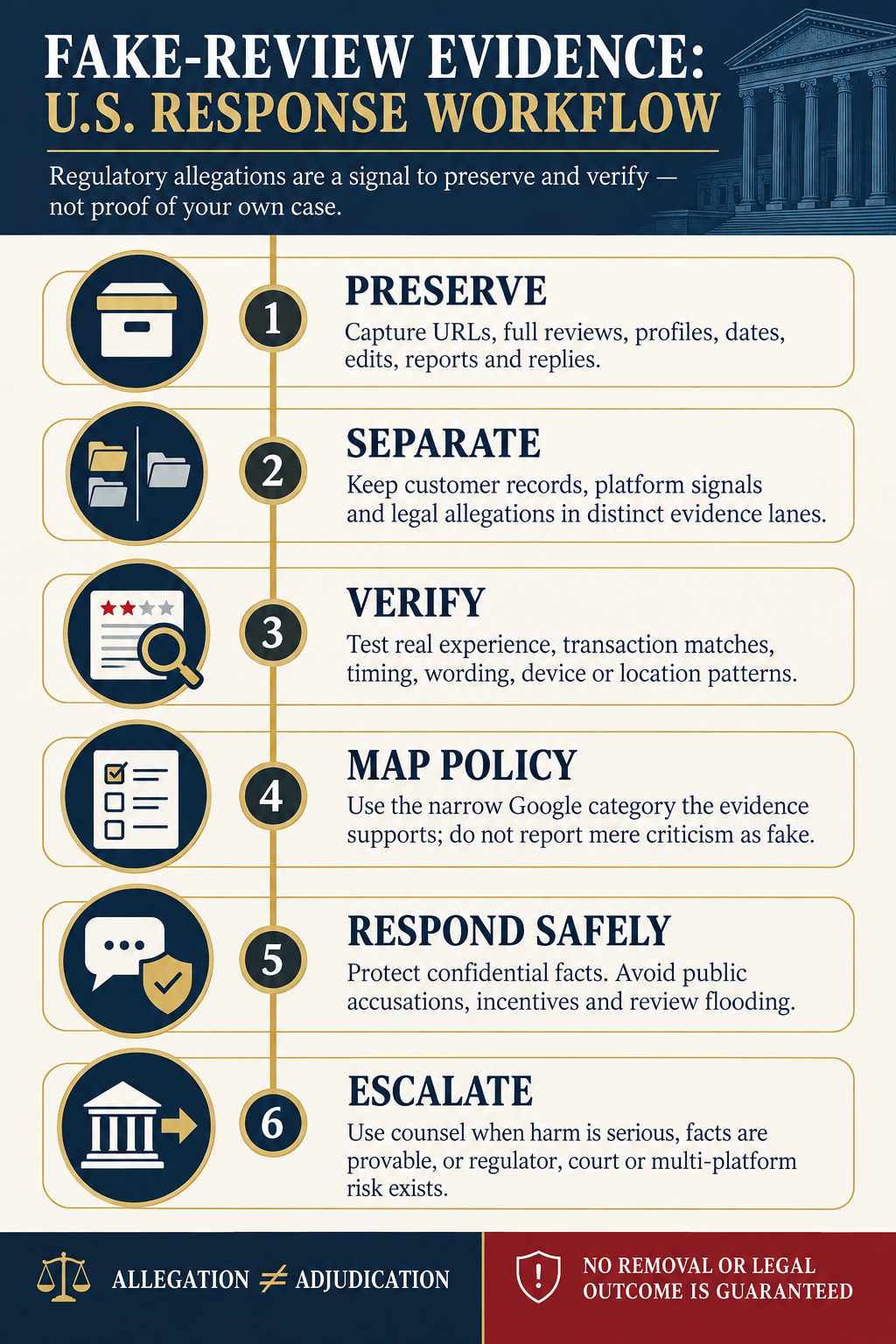
A Practical Six-Step Decision Sequence
- Preserve the complete review publication, reviewer profile, media, URLs, dates, edits, owner replies, reports, appeals, and off-platform contacts.
- Separate customer records, public pattern observations, platform decisions, legal allegations, and adjudicated facts into distinct evidence lanes.
- Verify whether a genuine experience occurred and record the systems checked, contradictions found, confirming facts, limitations, and chain of custody.
- Map the file to the narrowest Google policy category or, where genuinely necessary, to a defined jurisdiction-specific legal basis.
- Respond publicly only with facts that can be stated safely, preserving confidentiality and avoiding unsupported accusations, incentives, or review flooding.
- Escalate proportionately when the harm, proof, jurisdiction, urgency, regulator interest, or coordinated conduct justifies counsel or another authority.
Sources Consulted
- Federal Trade Commission press release announcing the GovAssist action (October 22, 2026).
- FTC complaint in FTC v. GovAssist LLC, Entry LLC, and Scott Zuckerman, Case No. 3:26-cv-01675 (D.P.R. filed October 22, 2026).
- FTC GovAssist case timeline and complaint docket link.
- FTC Consumer Reviews and Testimonials Rule questions and answers.
- 16 C.F.R. Part 465, the Consumer Reviews and Testimonials Rule.
- 15 U.S.C. Section 45, the FTC Act unfair-or-deceptive-practices provision.
- FTC guidance on the Consumer Review Fairness Act and 15 U.S.C. Section 45b.
- Google Maps prohibited and restricted content policy.
- Google Maps user-generated content policy overview.
- Google Business Profile review-reporting guidance and Reviews Management Tool.
- Google overview of legal content removals and Google defamation overview.
- 47 U.S.C. Section 230.
Practical Conclusion
The October 22, 2026 GovAssist complaint is a useful current example because it shows a regulator pleading review representations, platform investigation signals, notice, advertising context, and alleged consumer harm together. It remains a pending complaint. The allegations have not been reduced to a final liability judgment, the review findings concerned another platform, and the case does not create an automatic Google-removal rule for other businesses.
For a U.S. business facing suspected fabricated Google reviews, the sound response is evidence first: preserve the publication, test whether a genuine experience occurred, document patterns without overstating them, separate Google policy from state-law claims and FTC compliance, keep the public reply narrow, and escalate only when the proof and risk justify it. Removal, enforcement, damages, and other legal outcomes are never guaranteed. This article is general information, not legal advice for a particular review, company, person, or jurisdiction.