
How U.S. e-commerce businesses can handle false Google reviews, fake customer claims, order-record evidence, and review-rule risk. For e-commerce businesses, a damaging Google review is rarely just a communications problem. It can become a customer-record problem, a platform-policy problem, a defamation-risk problem, a privacy problem, and sometimes a regulatory-risk problem. A business should therefore avoid treating the review thread as the place to prove every fact. The stronger route is to build a disciplined file first, then decide what can safely be sent to Google, what can safely be said publicly, and what should remain in a counsel-controlled record.
This guide is written for a U.S. online store, marketplace seller, subscription brand, or direct-to-consumer company dealing with false reviews, online defamation, fake customer claims, coordinated reputation harm, or a review that mixes some legitimate criticism with serious factual accusations. It is informational only. It does not promise removal, and it does not replace state-specific legal advice. The practical objective is to reduce mistakes while the business preserves evidence and chooses a proportionate Google review removal strategy.

Legal Issue Framing For E-Commerce Businesses
A lawyer-grade review analysis starts with the text itself. In the working scenario, a U.S. e-commerce business receiving reviews alleging counterfeit products, non-delivery, stolen card use, fake refunds, and dangerous products. The first question is not whether management feels attacked. The first question is whether the review communicates a verifiable factual allegation to ordinary readers. Words such as rude, slow, disappointing, expensive, or unprofessional may be protected opinion or fair criticism. Accusations of fraud, theft, fabricated records, discrimination, safety violations, professional misconduct, or criminal behavior are different because they imply facts that may be capable of being proved true or false.
U.S. defamation law is state-based, but the federal constitutional frame matters. Milkovich v. Lorain Journal Co. is a useful Supreme Court reference because it rejects a simple label-based rule where calling something opinion automatically makes it immune; the key question is whether the statement can reasonably imply a false assertion of fact. New York Times v. Sullivan remains important for public-official and public-figure issues, while most local business review disputes turn on private-figure, state-law, fault, falsity, harm, and privilege questions. The business should not assume that every harsh review is actionable, and it should not assume that every factual accusation must stay online.
For related Pimlegal guidance, read the United States guide to anonymous Google review extortion and the United States Google review removal page. Those are the only contextual internal links in this article so the reader has one USA resource path and one country-service path.
Evidence Checklist: Preserve Before You Report
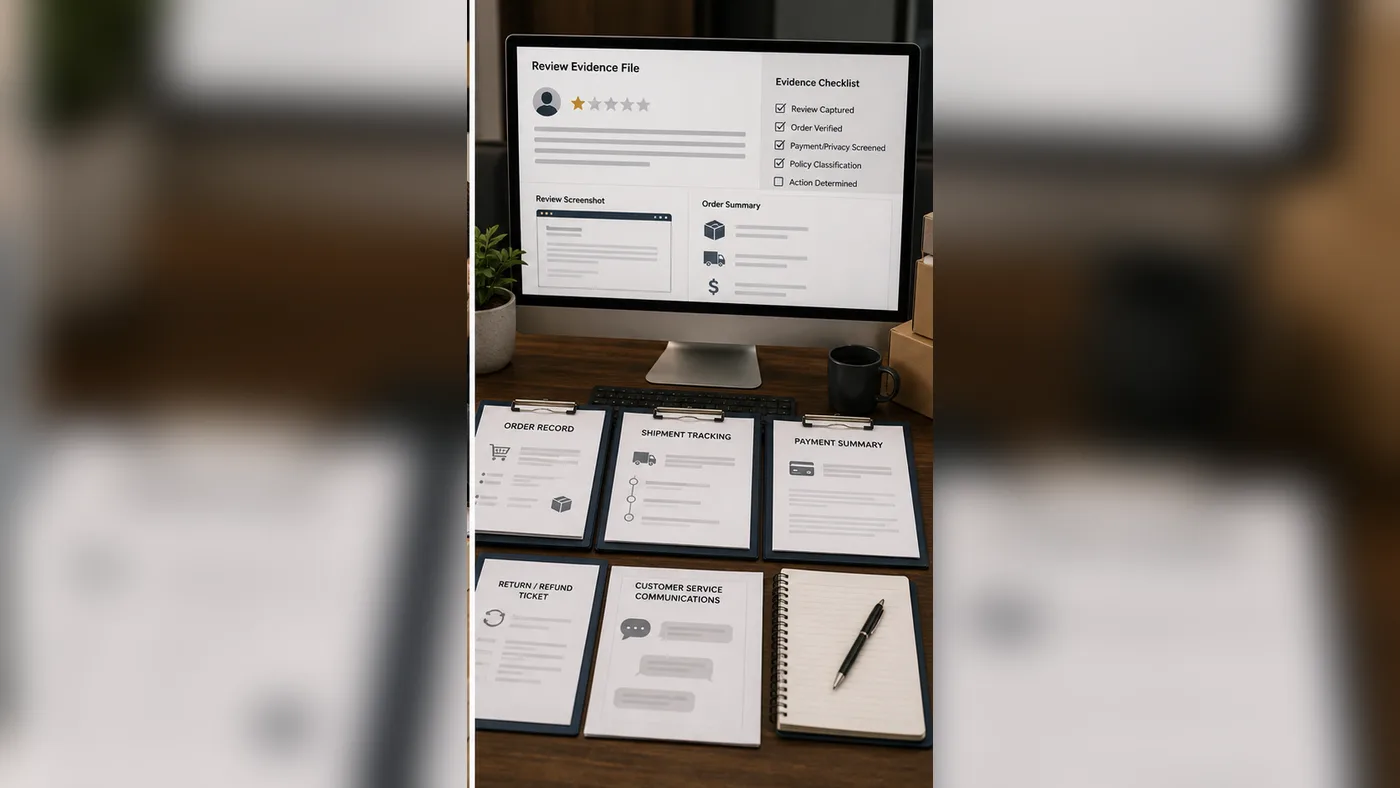
The evidence file should begin with capture, not conclusions. Preserve the review URL, reviewer display name, reviewer profile page, visible date, star rating, full text, images, owner replies, sorting context, and screenshots showing the Google Business Profile. If the review is edited, save each version. If the profile disappears, keep the original capture and a note explaining when it was last visible. For e-commerce businesses, the business should also preserve order records, payment processor logs, shipment tracking, return tickets, customer-service transcripts, refund records, fraud-screening notes, product batch records, and marketplace dispute files. Those materials do not all belong in a Google submission, but they are essential for counsel, management, and any later escalation.
The file should document negative checks as carefully as positive matches. If the reviewer cannot be found in records, note which systems were searched, by whom, on what date, and with which limitations. If the reviewer may be a real customer but the accusation is exaggerated, isolate the unsupported statements instead of pretending the whole review is fake. If the review is part of a pattern, build a chronology showing timing, similar wording, common profiles, sudden rating movement, related threats, competitor or former-employee context, and any off-platform messages.
- Capture the review, profile, URL, star rating, screenshots, images, publication date, edit history, and Business Profile context.
- Compare the accusation with order records, payment processor logs, shipment tracking, return tickets, customer-service transcripts, refund records, fraud-screening notes, product batch records, and marketplace dispute files.
- Create a sentence-by-sentence table: exact words, factual meaning, proof for or against, Google policy category, legal issue, and response risk.
- Preserve non-public records separately from the Google report so sensitive customer, patient, student, client, payment, or transaction details are not over-shared.
- Record business harm with contemporaneous evidence: lost bookings, canceled orders, prospect questions, rating movement, staff impact, and partner concern.
- Keep report IDs, Google decisions, appeal attempts, public-response drafts, and legal-review notes in the same chronology.
Platform-Policy Angle: Translate The File Into Google Categories
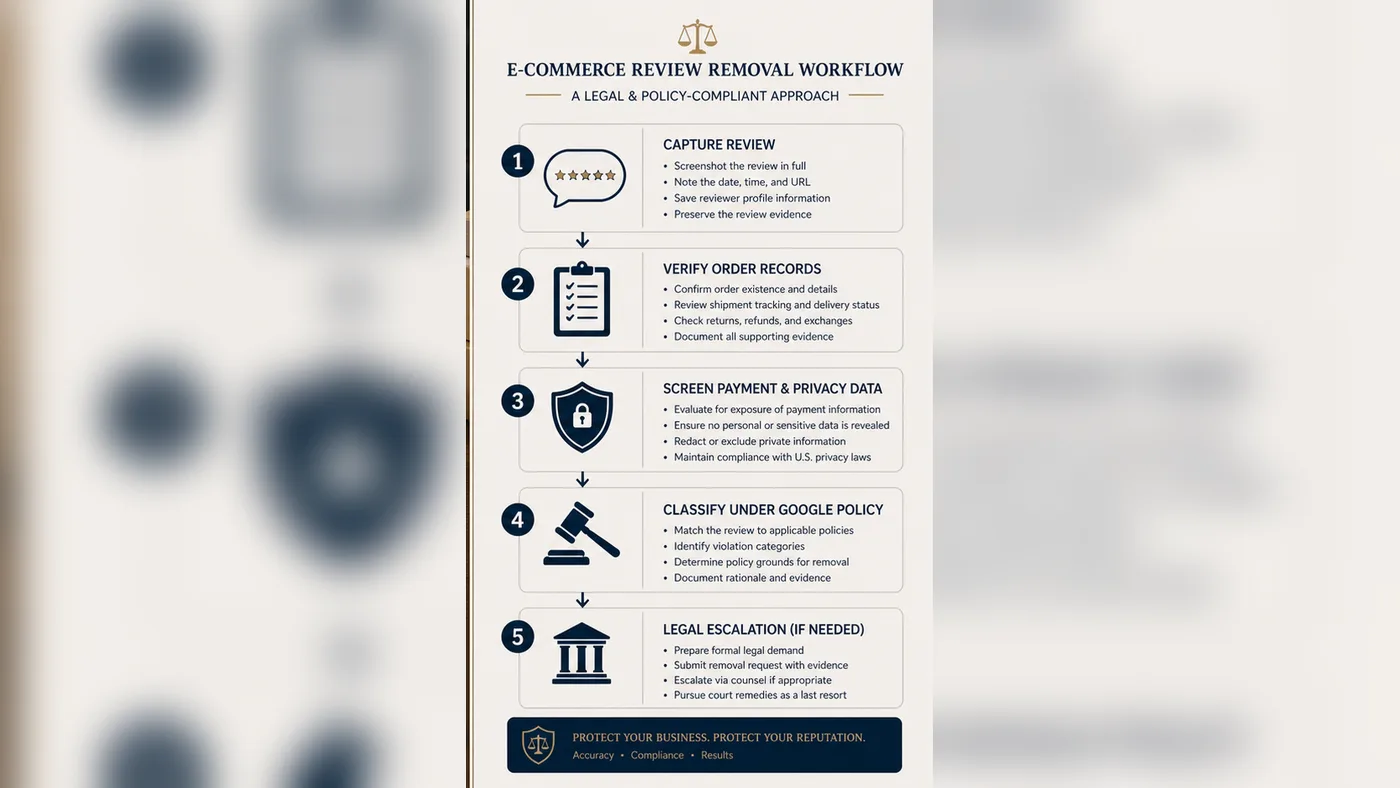
Google tells businesses to use the official review-reporting workflow when a review violates policy, not simply because the business disagrees with it. The most useful submission is therefore not a long emotional letter. It is a moderator-readable file: exact review text, short chronology, relationship check, non-confidential evidence summary, policy category, and requested outcome. For e-commerce businesses, the strongest policy angle may be fake engagement, misrepresentation, off-topic content, conflict of interest, or false claims that do not match any order record. The category should be chosen from the evidence, not from frustration.
Google's prohibited and restricted content policy is especially important because it focuses on content such as fake engagement, misrepresentation, harassment, personal information, and content that does not reflect a genuine experience. A review can be legally troubling but still need a platform-policy explanation to be removed by Google. Conversely, a review can violate Google policy without automatically proving a defamation claim. The business should keep the platform argument and the legal argument consistent, but separate.
The business also needs to avoid becoming the policy violator. Google's Business Profile restriction materials warn that fake-engagement violations can lead to profile consequences, and the FTC's Consumer Reviews and Testimonials Rule guidance explains that the federal rule, effective October 21, 2024, targets deceptive and unfair review practices. Online sellers also face the strongest FTC review-rule exposure because review generation, suppression, incentives, insider testimonials, and fake social indicators often sit inside the same growth stack. A harmed business should not buy counter-reviews, offer incentives for deletion, selectively invite only happy customers to post, or misuse fake-review reporting against truthful criticism.
Public Response Strategy: Protect Readers Without Waiving The File
The public response should be written for future readers, not for the reviewer alone. The safest wording is usually short, calm, and privacy-safe: acknowledge that the business takes the matter seriously, state that available records are being reviewed where appropriate, and invite the reviewer to a private official channel. The response should not disclose the evidence package. E-commerce teams should keep payment, delivery, fraud, return, and personal address data out of Google replies and ordinary platform submissions. The response also should not call the reviewer a criminal, extortionist, competitor, former employee, or liar unless counsel has reviewed the evidence and the business is willing to defend that wording.
The biggest response risk for e-commerce businesses is publicly posting order numbers, addresses, fraud flags, payment details, or customer-service transcripts to prove the review false. That risk is practical as much as legal. A public reply can become a screenshot in the next review, a complaint to a regulator, an exhibit in litigation, or a reason Google believes the dispute is a customer-service argument rather than a policy violation. If the review contains private information, threats, staff names, customer identifiers, health facts, student facts, payment details, or allegations of crime, the public response should be screened before publication.
Escalation Criteria: When Google Reporting Is Not Enough
Escalation may be justified when the review alleges serious factual misconduct, appears to be from a non-customer, exposes private information, contains threats or harassment, is part of a coordinated campaign, or is paired with an off-platform demand for money, refund, discount, service, or silence. Escalation may include a stronger Google appeal, a preservation letter, a reviewer notice, counsel-to-counsel communication, subpoena-readiness review, law-enforcement consultation for true extortion facts, or state-specific defamation analysis. The route depends on evidence and proportionality.
Expectations about platform liability should be realistic. 47 U.S.C. Section 230 generally prevents treating an interactive computer service as the publisher or speaker of third-party content. That does not immunize the reviewer who wrote a false review, and it does not prevent businesses from using Google's policy channels. It does mean that a legal strategy aimed directly at forcing the platform to act needs careful analysis. In many cases, the better first move is a stronger policy record and a cleaner evidence chronology.
- Escalate if the accusation is specific, factual, serious, and contradicted by objective records.
- Escalate if the reviewer appears to be a non-customer, competitor, former staff member, supplier, transaction opponent, or part of a coordinated pattern.
- Escalate if the review includes private information, threats, harassment, images, or staff/customer identifiers.
- Escalate if a first Google report was rejected because the submission lacked chronology, policy framing, or non-confidential evidence.
- Escalate if the public-response risk is high enough that legal or privacy review is needed before any owner reply.
Risk Cautions For U.S. Businesses
The Consumer Review Fairness Act, codified at 15 U.S.C. Section 45b, makes certain form-contract provisions restricting covered consumer reviews void, with enforcement mechanisms tied to the FTC and states. That matters because a business fighting false reviews may be tempted to add broad anti-review clauses, threaten fees for criticism, or demand intellectual-property transfers in review text. Those approaches can create a new legal issue even when the original review was unfair.
The FTC endorsement guides also warn against coercive review practices and misuse of fake-review reporting. The 16 C.F.R. Section 255.2 examples describe review threats and groundless fake-review flags as potential unfair or deceptive practices. For a U.S. online store, marketplace seller, subscription brand, or direct-to-consumer company, the practical rule is simple: challenge false, fake, or policy-violating content with evidence; do not suppress truthful negative reviews as a reputation shortcut.
Sources Consulted
- Google Business Profile Help: report inappropriate reviews.
- Google prohibited and restricted content policy.
- FTC Consumer Reviews and Testimonials Rule Q&A.
- 15 U.S.C. Section 45b, Consumer Review Fairness Act.
- Milkovich v. Lorain Journal Co., 497 U.S. 1 (1990).
- 47 U.S.C. Section 230.
- 16 C.F.R. Section 255.2 examples on review coercion and fake-review reporting misuse.
Practical Conclusion
Google review removal for e-commerce businesses in the United States works best when the business slows the dispute down just enough to preserve the file. Capture the review. Verify the records. Separate opinion from factual accusation. Choose the strongest Google policy category. Keep private evidence out of public responses. Avoid review-suppression tactics that create FTC or platform risk. Escalate only when the evidence supports a proportionate legal path.
Pimlegal's approach is to help the online store, marketplace seller, subscription brand, or direct-to-consumer company organize a legally useful evidence file, align the Google report with U.S. online defamation and consumer-review rules, and decide whether a public response, appeal, legal notice, subpoena-readiness review, or local counsel referral is appropriate. The goal is not to promise removal. The goal is to preserve leverage, avoid avoidable errors, and make each next step defensible.