
A practical U.S. guide for businesses deciding when a negative Google review can be removed, when it should be answered, and how to rebuild trust with evidence, policy discipline, and compliant review generation. The important word is deciding. Negative does not automatically mean removable. A one-star complaint can be truthful, subjective, mixed, exaggerated, or unfair without violating Google's rules. Another one-star review can be fake engagement, impersonation, extortion, harassment, personal information, a conflict-of-interest attack, or a serious false factual accusation. A U.S. business should separate those categories before it reports the review, answers publicly, contacts the reviewer, or starts a legal escalation.
This article is inspired by Cloutly's practical guide to removing negative reviews from Google, but it is written for a U.S. business that needs an evidence-led and compliance-aware workflow. Cloutly's useful commercial point is that removal is possible only with an asterisk: some content can be reported or escalated, while many genuine negative reviews should be answered and offset by better customer experience and authentic review generation. Pimlegal's angle is narrower and more legal: preserve the file, classify the issue, avoid review-suppression mistakes, and choose the next step from the evidence.
Can A Business Remove Negative Google Reviews?
A business owner cannot simply delete a Google review from a Business Profile because the review is embarrassing, commercially damaging, or unfair in tone. Google reviews are designed to reflect user experiences, and Google generally keeps reviews that do not violate policy. The realistic question is whether the specific review contains a removable feature. That feature may be platform-based, such as fake engagement or impersonation. It may be safety-based, such as threats, harassment, or personal information. It may be legal, such as defamation, copyright, privacy, or court-order issues. Or it may not be removable at all, in which case the best response is operational repair and a calm public reply.
Google's Business Profile review-reporting guidance says businesses can report reviews, but only reviews that violate policy are eligible for removal. Google's prohibited and restricted content policy then supplies the working categories: fake engagement, misrepresentation, impersonation, harassment, personal information, offensive content, off-topic content, restricted content, and conflicts of interest. A report that says only 'this is negative and hurting us' is weak. A report that identifies the exact words, the exact policy category, and the non-confidential evidence is much stronger.
The business should therefore use a three-part triage. First, remove when the record supports a policy violation or legal route. Second, respond when the review is genuine criticism, mixed opinion, or a real customer dispute that Google is unlikely to remove. Third, rebuild by asking real customers for honest feedback, fixing repeated service issues, monitoring new reviews, and preserving evidence for future incidents. This framework is more durable than trying to make every negative review disappear.
Read this with the USA bad Google review removal decision guide and the United States Google review removal page. Those are the two contextual internal links used in this article: one triage workflow and one country-service page.
Step 1: Capture The Review Before Anyone Acts
The first action is evidence preservation, not argument. Reviews can be edited, owner replies can change the tone of the record, reviewer profiles can disappear, and staff memories can drift. Preserve the review URL, reviewer display name, profile link, profile photo, star rating, full review text, photos or videos, visible date, edit signals, owner replies, and the Google Business Profile context. Save desktop and mobile screenshots if the review is especially serious. If the review appears in search results, local pack previews, or Maps, preserve that context too.
Then compare the review with internal records. Search POS systems, booking tools, invoices, contracts, CRM records, email, chat, refund logs, support tickets, call notes, branch schedules, staff rosters, delivery records, membership data, and complaint files. A no-match result should be documented carefully: which systems were searched, by whom, on what date, using which names, phone numbers, emails, order IDs, or date ranges. If the business may have walk-in customers, the file should acknowledge that limitation rather than overclaiming that the reviewer definitely never visited.
- Preserve the full review page, reviewer profile, URL, rating, text, images, date, edit evidence, and Business Profile context.
- Search customer, booking, invoice, POS, CRM, email, refund, call, location, and staff records before claiming the review is fake.
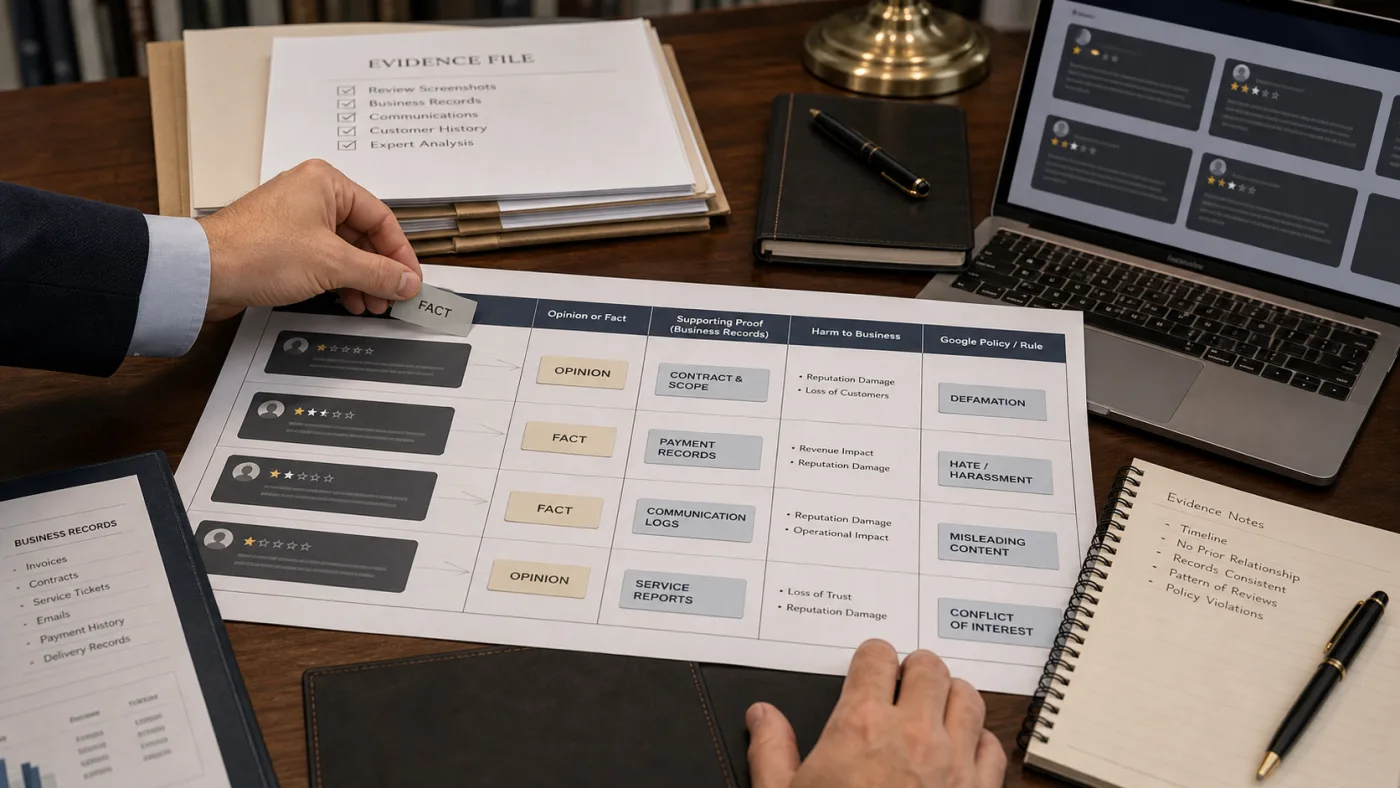
- Create an allegation table with exact words, factual meaning, proof, policy category, legal issue, and public-response risk.
- Keep confidential customer, patient, employee, payment, and legal records out of public replies and ordinary Google submissions unless counsel approves.
- Record report dates, selected Google categories, status updates, appeal timing, owner-reply drafts, and off-platform messages in one chronology.
Step 2: Classify The Negative Review
The review should be classified sentence by sentence. A statement such as 'slow service' or 'expensive' is usually ordinary opinion. A statement such as 'they stole my deposit,' 'the doctor falsified records,' 'the company is running a scam,' or 'the owner assaulted me' is more serious because it may imply verifiable facts. A review that says 'avoid this place' may be protected opinion. A review that posts a staff member's phone number, a patient's diagnosis, an invoice, or a threat to harm someone raises different issues. Classification prevents the business from forcing every problem into the fake-review bucket.
Some negative reviews should be reported as platform violations. Examples include a reviewer with no genuine experience, a competitor posting to manipulate ratings, a current or former employee reviewing the business as a customer, impersonation, spam, coordinated review bombing, threats, harassment, personal information, or off-topic political or social commentary. Other negative reviews should be answered rather than reported. A customer who had a real bad experience, describes it in harsh but subjective language, and avoids private information or false factual accusations may have written a review that the business dislikes but Google will keep.
Extortion deserves separate treatment. Google's negative review extortion guidance describes a recognizable pattern: a sudden increase in low-star reviews followed by a demand for money, goods, or services in exchange for removing the content. If that happens, the business should not pay, should not negotiate in anger, and should preserve every communication. The review itself may still need ordinary Google reporting, while the demand message may need the dedicated extortion route, counsel review, and possibly law-enforcement analysis depending on the facts.
Step 3: Report Only What The Evidence Supports
A strong Google report is short, factual, and easy to review. It identifies the exact review, quotes the policy-relevant words, explains the business-record check, states the policy category, and summarizes only the evidence Google needs. The business should avoid unsupported accusations such as 'this person is a criminal,' 'this is definitely a competitor,' or 'this review is defamatory' unless the file supports those words. A cleaner formulation is often stronger: 'We cannot locate a customer record for this name, phone number, date, service, or described transaction after checking these systems; the same profile posted similar one-star reviews against nearby competitors on the same day; this appears to be non-genuine experience or rating manipulation.'
If the review is mixed, report the removable part without pretending the entire review is fake. A real customer may write one legitimate complaint and one unsupported accusation. A former employee may also have had some customer interaction. A reviewer may exaggerate without fabricating the entire event. Overclaiming weakens the file and can make the business look like it is trying to suppress criticism rather than identify a real policy issue.
The federal consumer-protection layer matters because a review-removal strategy can create its own risk. The FTC's Consumer Reviews and Testimonials Rule Q&A explains that the Consumer Reviews and Testimonials Rule, effective October 21, 2024, addresses deceptive and unfair review practices. The Consumer Review Fairness Act at 15 U.S.C. Section 45b also restricts certain form-contract provisions that penalize or restrict covered consumer reviews. A business may challenge fake, unlawful, or policy-violating content, but it should not threaten honest customers, use false accusations, buy positive counter-reviews, or offer benefits in exchange for deletion.
Step 4: Respond When The Review Is Genuine Criticism
Many negative reviews should be answered rather than removed. That is not a failure. A thoughtful public response can show future customers that the business listens, protects privacy, and handles criticism without becoming defensive. The safest response is usually short: thank the reviewer for the feedback, state that the business takes the concern seriously, avoid debating private details, invite the reviewer to a private official channel, and state that the team will review the matter. The reply should be written for future readers, regulators, platforms, and possible legal review, not just for the person who posted the review.
Google's manage customer reviews guidance is important because owner replies are public and appear as the business. A reply can help rebuild trust, but it can also become evidence. Do not reveal receipts, health information, staff discipline, settlement discussions, private emails, security footage, debt details, or customer records. Do not contradict the removal file. If the Google report says the reviewer is not in records, do not reply as if the visit is remembered. If the report says the review exposes personal information, do not repeat the personal information in the response.
A genuine negative review can also identify an operational issue. If multiple reviews mention slow appointments, hidden fees, rude intake, delivery delays, cancellation confusion, or poor follow-up, the answer is not only reputation management. The answer may be a process fix, staff training, clearer pricing, better confirmation messages, or faster complaint handling. A business that fixes the repeated issue and responds calmly will often look more trustworthy than a business that tries to scrub every criticism from its profile.

Step 5: Appeal Once With A Better File
If Google refuses the first report, do not immediately resubmit the same complaint in louder language. Rebuild the file. Did the first report choose the wrong category? Did it fail to explain the customer-record search? Did it omit the exact words that violate policy? Did it attach too much confidential material? Did the public response make the matter look like an ordinary customer-service dispute? Did the review combine subjective opinion with one separable factual accusation that should have been isolated?
Treat the appeal as a single-shot memo. State the review URL, the reviewer's visible identity, the exact policy category, the exact text at issue, the non-confidential evidence summary, and the reason the earlier decision should be reconsidered. Add new facts if available. Remove unsupported labels. If the review contains personal information, identify the exposed category without repeating unnecessary private data. If the issue is conflict of interest, explain the relationship. If the issue is fake engagement, explain why there is no genuine experience. If the issue is a legal falsehood, keep the legal analysis precise and proportionate.
U.S. legal escalation should remain realistic. Milkovich is useful because some statements framed as opinion can still imply false assertions of fact, but not every bad review is defamatory. 47 U.S.C. Section 230 also limits attempts to treat platforms as publishers of third-party content, although it does not protect the reviewer who wrote a false statement and does not prevent Google from reviewing policy or legal-removal requests. If the matter truly involves defamation, privacy, copyright, threats, extortion, impersonation, or a court order, the Google Legal Help Center may be relevant, but the submission should identify exact URLs, exact statements, the legal basis, and the remedy sought.
Ask The Reviewer Only In A Compliant Way
Sometimes the right route is service recovery. If the reviewer is a real customer and the business can identify the issue, the business may contact the customer through an appropriate private channel, listen, fix what can be fixed, and invite the customer to update their review if they feel the matter was resolved. The request should be voluntary, neutral, and not tied to a benefit. Do not offer a refund, discount, free service, gift card, or special treatment in exchange for deleting or changing the review. Do not pressure the customer, threaten legal action as a shortcut, or make the review change a condition of resolving the complaint.
At the same time, the business should build review resilience with real customers. Ask customers consistently for honest feedback. Make the request after normal service milestones. Do not review-gate by asking happy customers to post publicly while routing unhappy customers into a private form. Do not buy reviews. Do not ask employees, agencies, friends, or family to pose as customers. A profile with steady, recent, genuine reviews is harder to damage and easier for future readers to interpret when one negative review remains live.
What Not To Do
Do not pay a reviewer for deletion. Do not buy fake positives to bury criticism. Do not report every negative review as fake. Do not ask multiple staff members to mass-flag a real customer complaint without evidence. Do not publish private records to prove the customer wrong. Do not accuse a reviewer publicly of fraud, extortion, stalking, identity theft, or competitor sabotage unless the evidence file is strong and counsel has reviewed the wording. Do not create anti-review contract terms, penalty clauses, or intellectual-property transfers that punish consumer reviews.
Also avoid timing mistakes. If a review contains threats, personal information, staff names, patient facts, financial details, or serious accusations, pause before replying publicly. If the reviewer is known and the business is considering a demand letter, preserve the evidence before contact. If the review is connected to an off-platform demand, preserve the entire message chain. If Google refuses removal, record the decision and appeal status. The practical discipline is simple: no deletion panic, no public fight, no unsupported legal threat, no private-data disclosure, and no deceptive review-generation shortcut.

Sources Consulted
- Google Business Profile Help: report inappropriate reviews.
- Google prohibited and restricted content policy.
- Google Business Profile Help: manage customer reviews.
- Google negative review extortion scam reporting guidance.
- FTC Consumer Reviews and Testimonials Rule Q&A.
- 15 U.S.C. Section 45b, Consumer Review Fairness Act.
- Milkovich v. Lorain Journal Co., 497 U.S. 1 (1990).
- 47 U.S.C. Section 230.
- Google Legal Help Center.
Practical Conclusion
To remove negative Google reviews in the USA, start by accepting that not every negative review should or can be removed. Preserve the review. Classify the words. Compare the claim with business records. Report only what fits Google's policy. Use the appeal carefully. Escalate legally only when the facts justify it. Respond to genuine criticism in a calm, privacy-safe way. Keep asking real customers for honest reviews through a neutral process. That mix of removal, response, and rebuilding is more credible than trying to erase every criticism.
Pimlegal's role is to turn a stressful review problem into a structured file: evidence capture, customer-record verification, policy mapping, public-response control, FTC-aware review practices, appeal preparation, and counsel referral where the facts support a legal route. The objective is not to promise deletion. The objective is to protect trust, preserve leverage, avoid avoidable compliance mistakes, and help the business choose the next defensible step.