
A Thailand-focused playbook for handling harmful Google reviews lawfully: platform-policy reporting, Thai defamation analysis, evidence preservation, extortion red flags and careful escalation.
Bad review removal is not a shortcut: it is an evidence exercise
Businesses in Thailand often discover the commercial power of a Google review at the worst possible moment: a new one-star review appears in Google Maps, the allegation looks exaggerated or false, and the rating sits directly beside the phone number, directions button and booking link. The temptation is immediate. Someone promises to "remove bad reviews from Google" quickly. Another agency says it has a private contact. A third suggests mass reporting, copyright complaints or pressure tactics. Some of those methods may temporarily hide content, but they can also create legal, platform and reputation risk for the business that uses them.
This guide is based on a simple distinction. There are legitimate ways to challenge a harmful review: a precise Google policy report, a documented conflict-of-interest complaint, a privacy or harassment report, a legal notice, a court-backed remedy, or a negotiated correction where the reviewer is known. There are also unsafe shortcuts: false copyright claims, fake reports, paying people to alter reviews, threatening customers publicly, or trying to bury legitimate criticism with fake positive reviews. In Thailand, the difference matters because the same dispute can involve Google policy, Thai criminal defamation, civil reputation claims, evidence preservation, data privacy and business records.
The TrustReviews article that inspired this discussion, Google Review Removal: How to Remove Negative & Fake Reviews, gives a useful general framework: identify whether the review violates Google policy, use the right reporting channel, preserve evidence, respond carefully when removal is not available, and avoid shortcuts that can backfire. The Thailand version of the problem is more sensitive because the same facts can also involve Thai criminal defamation, civil liability, data privacy, business records and platform enforcement. The right strategy is not "delete everything negative". It is to identify what is false, unlawful, inauthentic or out of policy, then choose the narrowest action that can solve the problem.
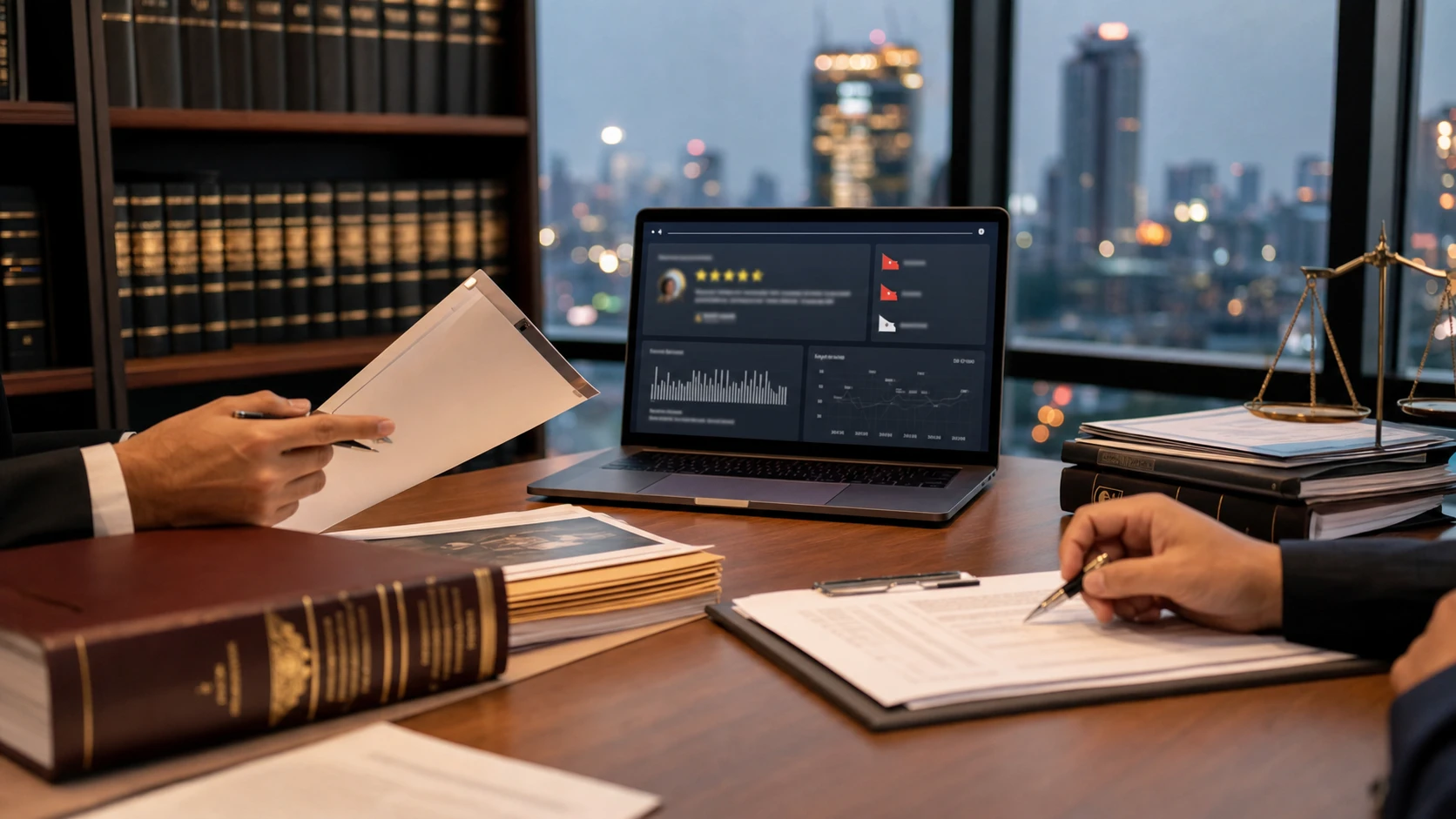
The three lawful routes to Google review removal
A business cannot directly delete another person's Google review. The practical question is whether the review can be removed by the platform, withdrawn by the reviewer, or addressed through a legal process. Those are different routes, and each one has a different evidentiary threshold.
First, platform-policy removal. Google removes content when it violates the Google Maps user-generated content rules. As of June 2026, Google's policy framework covers issues such as fake engagement, rating manipulation, conflicts of interest, impersonation, misrepresentation, harassment, offensive content, personal information, spam and off-topic content. Google's Business Profile help page is equally clear that a review is eligible for removal only when it violates policy, not merely because the business dislikes it. A good report identifies the exact policy category and explains how the facts fit it. A weak report says only "this review is false" or "this person is lying". That usually is not enough.
Second, reviewer-side correction or withdrawal. If the reviewer is identifiable and the dispute is a genuine misunderstanding, a calm private resolution may be better than a legal fight. This can include correcting a factual error, refunding a documented billing mistake, or asking the reviewer to update the review voluntarily after the issue is resolved. The request must not be coercive and should never offer incentives in exchange for revision or removal, because Google policies restrict incentives for reviews and review changes.
Third, legal escalation. A formal legal route may be appropriate where the review contains false factual allegations, accusations of crime, identity misuse, personal data, extortion, competitor attacks or a coordinated campaign. In Thailand, legal analysis may involve the Criminal Code, the Civil and Commercial Code, the Computer Crime Act and, in some cases, the Personal Data Protection Act. The legal route can support a platform submission, a notice letter, a civil claim, a criminal complaint or an application for court-backed relief, depending on the facts.
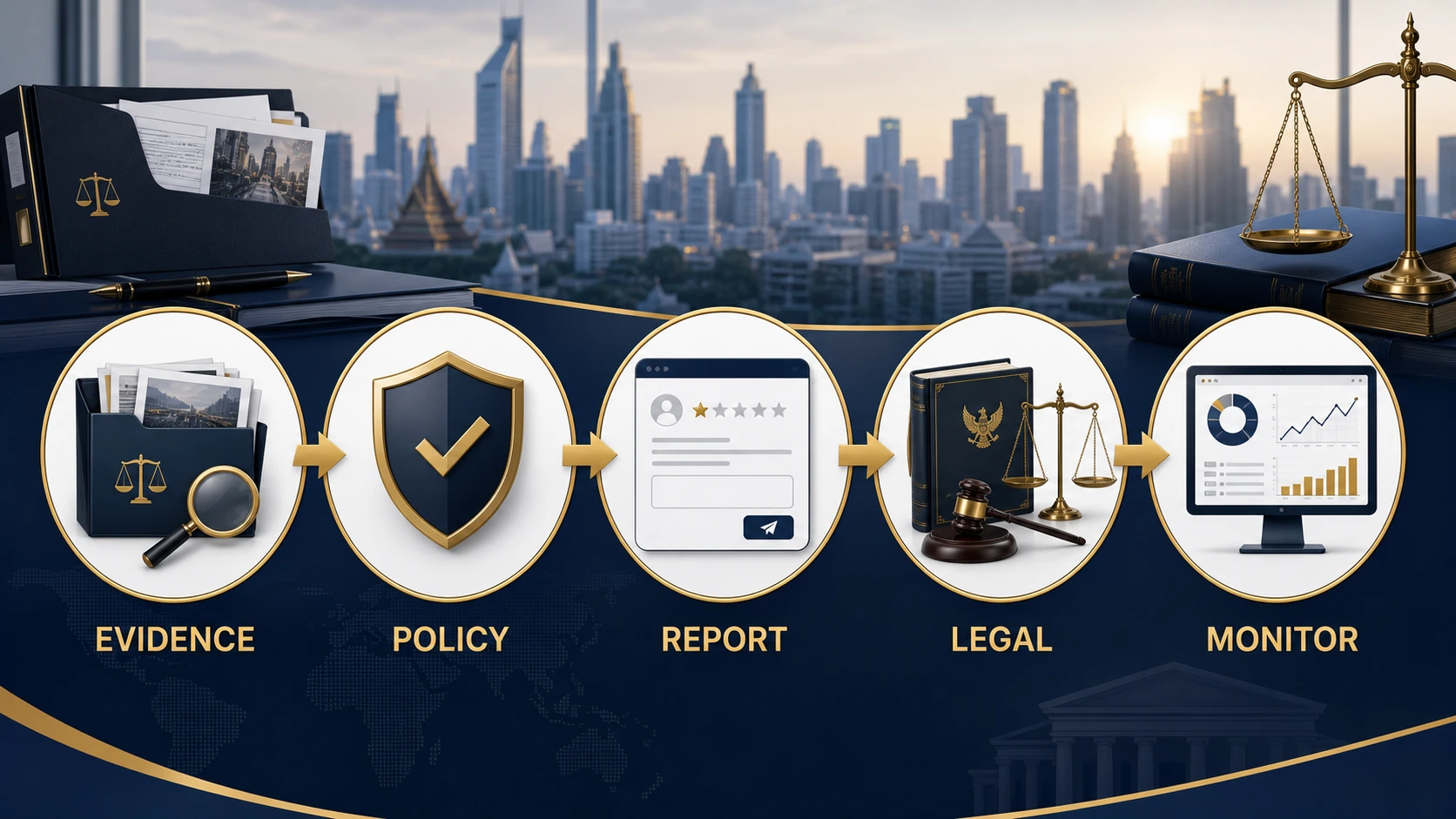
Google policy: what usually gives a removal request traction
For most businesses, the first pass should be platform policy, not litigation. Google is not a Thai court. It is deciding whether a review belongs on Google Maps under its own rules. A report that mirrors Google's language is easier to evaluate than a long emotional complaint.
Common policy-based grounds include a reviewer who never used the business, a review posted by a competitor, a former employee or a person with another conflict of interest, repeated reviews from connected accounts, review bombing after a social-media dispute, off-topic political attacks, threats, hate speech, disclosure of personal information, wrong-business reviews, and content that makes unsupported accusations of criminal or unethical behavior. When these facts exist, the report should be short, specific and supported by records.
Google now also provides a specific path for negative-review extortion scams. That route is for cases where a malicious person or group demands money, goods, services or other favors in exchange for removing or stopping negative reviews. It is not a generic appeal form. A Thailand business should use it only when there is real extortion evidence: messages, dates, account names, affected review links, screenshots and a timeline showing the demand.
For example, if a restaurant receives ten one-star reviews within an hour from accounts that never visited Thailand, the strongest report is not "these people hate us". It is a pattern-based fake engagement report with timestamps, reviewer profile screenshots, booking records and a short explanation of why the review activity does not reflect genuine customer experience. If a clinic receives a review naming a nurse, medical issue and private contact details, the strongest report may be personal information, privacy and harassment, plus a measured legal assessment. If a hotel receives a review meant for another branch or another company, the report should show the mismatch.
For a broader local strategy, see PimLegal's internal guide to Google review removal in Thailand. For evidence preparation, see the Google review dispute evidence checklist.
Thai legal texts that may matter
When a review moves beyond ordinary criticism, Thai law can become relevant. The exact route depends on the words used, whether the statement is fact or opinion, whether it is false, whether it was published to others, and what damage can be shown.
Thai Criminal Code section 326 is the core criminal defamation provision. In plain language, it concerns imputing something to another person before a third person in a manner likely to impair reputation or expose that person to hatred or scorn. For online reviews, the third-party publication element is usually obvious because the review is public. The harder questions are whether the statement is factual, whether it is damaging, whether it is false or misleading, and whether any defense may apply.
Thai Criminal Code section 328 can increase exposure where defamation is committed by publication, broadcasting or similar means. A Google review, Facebook post, TikTok caption, forum post or other online publication may require this analysis. Section 328 is one reason businesses and reviewers should both take online accusations seriously in Thailand. It is also a reason not to threaten criminal action casually. A complaint should be proportionate, evidence-backed and reviewed before filing.
Sections 329 and 330 may be relevant to defenses or exceptions, including good-faith comment in certain contexts and truth where the legal requirements are met. These defenses are fact-specific. A business should not assume that every damaging review is automatically criminal defamation, and a reviewer should not assume that "it was my opinion" solves every problem. Mixed statements are common: a review may contain a subjective complaint, a true factual detail and a false accusation in the same paragraph.
Civil and Commercial Code section 423 is important when the objective is compensation or civil relief. It is commonly discussed where a person circulates a false statement of fact contrary to the truth and causes damage to reputation, credit, earnings or other interests. In a business review case, civil evidence may include booking cancellations, lost leads, reduced conversion, staff disruption, supplier concern, advertising impact and customer messages that refer to the review. For more detail, see PimLegal's guide to civil liability for false statements under section 423.
The Computer Crime Act is not a magic button for every bad review. It may matter where the conduct involves false or distorted computer data, impersonation, fake-account activity, hacked access, manipulated online campaigns, damaging images or other digital conduct beyond a normal consumer complaint. Because section 14 can be complex and has been controversial in online-speech disputes, it should be assessed carefully before it is included in a strategy.
The evidence file: what to collect before doing anything
Most review-removal failures begin with poor evidence. A business sees the review, becomes angry and immediately replies, reports it, messages the reviewer or posts about it. By the time a lawyer reviews the case, the original profile may have changed, the review may have been edited, the business may have posted a risky response, and the internal records may be incomplete. The better approach is to freeze the record first.
At minimum, collect the review URL, screenshots of the review in Google Search and Google Maps, the reviewer profile, the date and time visible on the review, any attached photos, the Google Business Profile concerned, related ratings, the business response if any, and any prior interaction with the reviewer. Then collect internal proof: booking logs, reservation records, invoices, receipts, delivery proof, chat history, CRM notes, staff statements, CCTV availability, refund records, complaint files and email threads.
For hospitality, wellness and appointment-based businesses in Bangkok, the service trail is often just as important as the legal argument. A false review might allege that a client paid for a treatment that was never delivered, that hygiene standards were unsafe, or that a refund was refused. A strong venue can still be commercially affected by a fabricated allegation, even when it is positioned online as the Best spa in Bangkok. Before escalating, reconcile booking records, payment logs, service notes, refund records and staff statements so the platform report or legal notice rests on facts, not anger.
Evidence should be preserved before deletion requests. If the review contains personal data or harmful allegations, capture it securely and restrict internal access. Do not edit screenshots, do not crop away context, and do not fabricate a customer-history explanation. A removal request that exaggerates the facts can damage credibility with Google, with the reviewer, and later with a court.
Unsafe shortcuts: why they are dangerous in Thailand
Some review-removal sellers claim they can make content disappear even when there is no policy violation. TrustReviews rightly warns businesses to focus on policy violations, evidence and professional responses rather than shortcuts. The same lesson applies in Thailand: a removal method that depends on deception can create more risk than the review itself.
A false copyright complaint may look attractive because copyright takedown systems can be automated. But if the review is not copying protected content, using copyright as a pretext is dangerous. It can be misleading to the platform, unfair to the reviewer, and damaging if the story becomes public. It may also distract from the stronger lawful route, such as showing that the review is fake engagement, a conflict of interest or a defamatory factual allegation.
Mass reporting is also risky. If employees, friends or vendors are instructed to report a legitimate review repeatedly, the business may appear to be manipulating the platform rather than documenting a real violation. Paying for fake positive reviews to dilute a negative review is worse. Google policies restrict fake engagement and rating manipulation, and a business caught doing it can face profile restrictions, review removal, ranking harm and public trust loss.
Public threats are another common mistake. A business might reply: "We will sue you for criminal defamation unless you remove this now." Sometimes a legal warning is justified, but a public threat can amplify the review, make the business look aggressive, and create screenshots that circulate outside Google. A safer public response is brief, factual and non-accusatory, while legal steps are handled privately.
Five common Thailand review scenarios
1. The fake customer review. The reviewer claims to have used the service, but the business has no matching booking, no invoice, no chat, no delivery record and no location evidence. The strongest path is an evidence-backed platform report, supported by internal records. If the review contains false damaging facts, civil or criminal analysis may follow.
2. The competitor or former employee review. Google policies can treat conflicts of interest as a problem. The business should not make unsupported accusations, but if it can document the relationship, the report can be powerful. Evidence may include employment records, LinkedIn profiles, email threads, supplier correspondence or other material showing a conflict.
3. The accusation of crime or professional misconduct. A review saying "this company is slow" is different from "this company stole money" or "the manager committed fraud". Accusations of criminal conduct can be defamatory if false and damaging. They may also require a careful public response, because repeating the accusation in the response can increase visibility.
4. The privacy or staff-naming review. Reviews sometimes identify employees, disclose personal phone numbers, discuss medical or family details, or attach images of staff. The strongest route may combine Google personal-information policy, harassment policy, PDPA awareness and internal HR care. The business should protect the staff member while avoiding overbroad claims.
5. The coordinated review attack. A sudden wave of similar reviews, especially after a social-media dispute, may point to fake engagement or harassment. In this scenario, pattern evidence matters more than one review in isolation. Save the timeline, reviewer handles, similar phrasing, off-platform posts calling for reports or negative reviews, and any messages demanding payment or action.
How to write a better Google removal request
A good removal request is short and structured. Start with the review URL and the exact policy ground. Then give two or three facts that prove the issue. Attach or retain evidence. Avoid insults, speculation and legal overstatement. If the review is defamatory, explain the false factual allegation in neutral terms and preserve the legal analysis for a formal notice or counsel-prepared submission.
For example: "This review appears to be a conflict-of-interest review and fake engagement. The reviewer is a former employee terminated on [date], the review was posted two days after termination, and the allegations do not correspond to any customer transaction. We attach employment confirmation and booking-search evidence." That is more persuasive than "This is a fake review and must be deleted."
When to escalate beyond Google
Escalation is appropriate when the review is serious, false, damaging and unlikely to be solved by a simple report. But escalation should be staged. A private legal notice may be suitable where the reviewer is known and a correction is realistic. A civil claim may be considered where loss or damage can be shown. A criminal complaint may be considered where the words meet the elements of criminal defamation and the business accepts the procedural and reputational implications. A platform escalation may be strengthened by legal analysis, but it should still map back to the platform's rules.
Timing matters. Criminal defamation in Thailand can involve limitation issues, while online evidence can disappear quickly. A business should avoid waiting months if the review is materially harming bookings or search conversion. At the same time, rushing into police complaints over a review that is mostly opinion can look disproportionate and may backfire commercially.
For a deeper explanation of Thai criminal defamation provisions, see PimLegal's article on Criminal Code sections 326 to 333. For live assistance, the next step is a confidential assessment through PimLegal's contact page.
A safe public response framework
Not every review should receive a public reply, especially if the reply would repeat a defamatory allegation or disclose private information. When a reply is useful, keep it professional. A safe structure is: acknowledge concern, state that the business cannot verify the account from available records if true, invite private contact, and avoid revealing details. Do not call the reviewer a liar unless counsel has reviewed the wording. Do not publish the customer's invoice, private messages or ID details. Do not argue line by line.
Practical checklist before hiring a review-removal service
Before paying anyone to remove a Google review, ask five questions. What exact policy or legal basis will be used? What evidence is required? Will the service make any copyright, impersonation or legal claim on your behalf? Will it ask third parties to mass report the review? Will it guarantee deletion even where the review appears to be a genuine opinion? If the answer is vague, be careful.
A credible adviser will tell you when removal is unlikely. They will separate platform policy from Thai law. They will refuse false claims. They will preserve evidence before reporting. They will explain risk, timing and alternatives, including public response, customer resolution, monitoring, civil action or criminal analysis where appropriate.
Reference points for businesses
For platform rules, review the official Google Maps prohibited and restricted content policy, Google's Business Profile review-reporting guidance, and Google's negative-review extortion scam guidance. For the base article that prompted this Thailand adaptation, see TrustReviews' guide to removing negative and fake Google reviews. For Thai-law orientation, review the available English translation of the Thai Criminal Code, Civil and Commercial Code section 423, and the Computer Crime Act only with fact-specific advice. This article is general information as of June 2026 and is not a substitute for legal advice.
If your Thailand business is dealing with a harmful Google review, preserve the evidence first, do not use deceptive shortcuts, and ask for a confidential assessment before escalating. The most effective removal cases are built on truth, documentation and proportional action.